The PASS acronym, Pull, Aim, Squeeze, Sweep, is the universally standardized method for operating a portable fire extinguisher. It appears on the operating instruction label of virtually every fire extinguisher manufactured for the US market, it’s the framework used in OSHA-compliant fire safety training, and it’s the mental script that can save your life (and others’) in the critical seconds of a fire emergency when panic threatens to override rational action.
Understanding PASS goes beyond memorizing four words. Effective application under real fire conditions requires knowing what each step means mechanically, what common mistakes to avoid, how PASS integrates with the broader RACE emergency response framework, and why having a properly maintained fire extinguisher is the prerequisite that makes PASS possible. This comprehensive guide covers all of it.
P — Pull the Pin
The pull pin is a safety device designed to prevent accidental discharge during transport, storage, and handling. It passes through the handle mechanism and physically blocks the handle from being squeezed. When you pull the pin, you’re removing the only thing preventing the extinguisher from discharging. Which means the extinguisher is now ready to fire the moment you squeeze the handle.
That said, Pulling the pin correctly: grasp the pin ring firmly with two fingers or a thumb-and-forefinger grip, point the extinguisher away from yourself and others, and pull the pin straight out with a firm, smooth pull. Don’t jerk it or yank it sideways. Pins are occasionally tight, and a sideways pull can bend or break the pin, making it difficult to remove. If the pin is hard to pull, try a smooth, firm pull while keeping the extinguisher pointed away from people.
After removing the pin, discard it or set it aside. You do not need the pin while using the extinguisher, and holding it takes up a hand. One common mistake: people keep the pin in one hand while trying to operate the extinguisher with the other. This makes the squeeze-and-sweep motion less stable.
A missing or broken pull pin is a serious problem discovered during monthly inspections. If your extinguisher’s pin is missing, the unit may have been used or mishandled and should be brought to a licensed technician for evaluation. A missing tamper seal (the plastic zip-tie through the pin) without a missing pin means the pin has been removed and re-inserted. The technician should verify no discharge has occurred and the unit is fully charged before returning it to service. Serviced Fire Equipment provides fast walk-in inspection service for any extinguisher showing these issues.
A — Aim at the Base of the Fire
Worth noting, Aiming at the base of the fire is the step that most confuses people who haven’t had hands-on training. The instinct is to aim at the most visible, dramatic part of a fire. The flames. But flames are just the combustion products of burning material. They’re where the energy is released, but they’re not the source. Suppressing the fuel at the base. The material that’s actually burning. Is what stops the fire. Aiming at the flames just disrupts them temporarily without addressing their source.
Practical aim for different fire types: for a paper or cardboard fire, aim at the surface of the burning material at the base of the flames. For a flammable liquid fire in a container, aim at the near edge of the burning liquid surface at the base of the flames. For a small equipment fire, aim at the equipment surface where the fire originates. The common theme is: find where the burning material meets the air, and put your agent there.
Standoff distance matters. Most fire extinguisher labels specify an effective operating range. Typically 6 to 10 feet for ABC dry chemical units. Too close, and the discharge stream may scatter burning material or blow flammable liquid out of a container, spreading the fire. Too far, and the agent disperses before reaching the base of the fire with adequate concentration to suppress combustion. Practice positioning at the recommended standoff distance during training. For construction sites, restaurants, and facilities in Tampa Bay, knowing the standoff distance for your specific extinguisher type makes training more effective.
Worth noting, CO₂ extinguishers have a shorter effective range than ABC units. Typically 3-8 feet. Because CO₂ gas disperses rapidly. When using a CO₂ extinguisher, you need to work closer to the fire, while being careful about the cold discharge (CO₂ discharge can cause frostbite on bare skin and can displace oxygen in enclosed spaces).
S — Squeeze the Handle
What’s more, Squeezing the handle activates the valve that releases the firefighting agent. The handle on most stored-pressure extinguishers (ABC, CO₂, Class K) is a lever mechanism that opens the valve when pressed down toward the cylinder. A firm, steady squeeze produces the best results. A hesitant, partial squeeze may produce an inconsistent discharge stream that doesn’t effectively suppress the fire.
Squeeze technique: place your dominant hand on the handle, your other hand supporting the base of the extinguisher or holding the hose near the nozzle (not near the discharge end. The agent coming out is under pressure and can cause injury at close range). Squeeze the handle firmly and smoothly, maintaining even pressure throughout the discharge. Do not pump the handle. This disrupts discharge and doesn’t increase effectiveness.
By contrast, For cartridge-operated extinguishers (less common than stored-pressure, but found in some commercial settings), the activation sequence is slightly different: the cartridge must be punctured first by pressing the puncture mechanism, then the discharge trigger is operated. Training on your specific extinguisher type ensures you know which mechanism you’re working with.
Critically, One important consideration: releasing the handle stops the discharge. This allows you to conserve agent if the fire is partially suppressed and you need to reposition, or to stop if conditions change and evacuation becomes necessary. The ability to stop discharge is a tactical advantage. It means you’re not committed to emptying the extinguisher the moment you start. This gives you flexibility to respond to how the fire behaves.
S — Sweep Side to Side
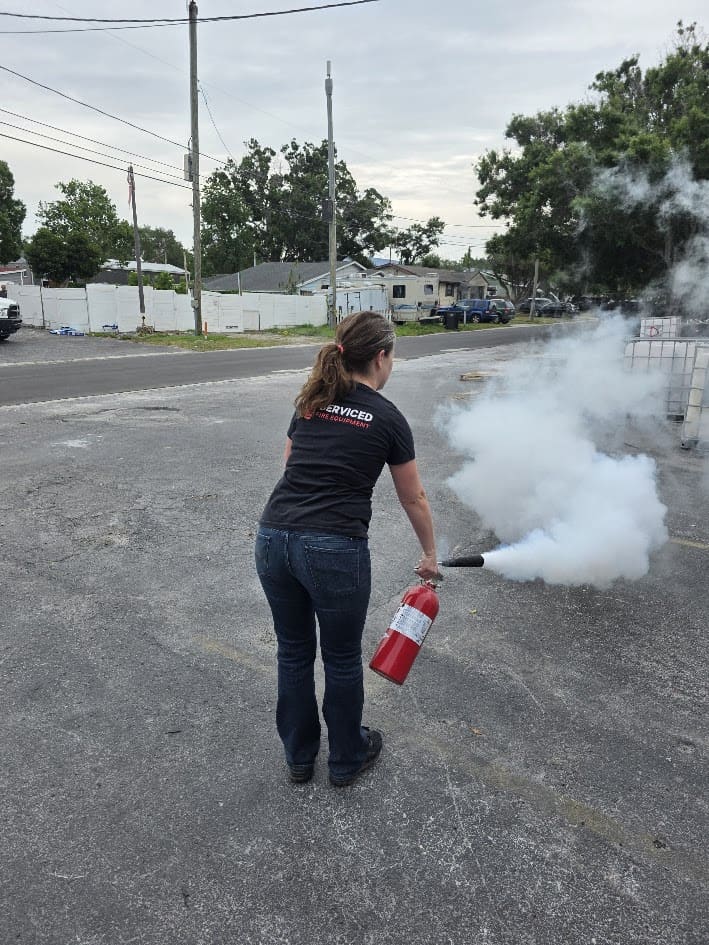
The sweep technique maximizes coverage of the burning area. Move the nozzle steadily from side to side, keeping the discharge aimed at the base of the fire throughout the sweep. The sweeping motion ensures that the entire burning surface receives agent, rather than suppressing one spot while the fire continues in adjacent areas.
Sweep speed matters. Too fast and you’re not delivering adequate agent concentration to any single area for effective suppression. Too slow and you’re depleting your agent on one area while the fire spreads around you. A moderate, even sweep. Roughly one to two feet per second at close range. Delivers the best results. As the fire begins to shrink, narrow your sweep to focus on the remaining active areas.
That said, For flammable liquid fires (Class B), the sweep should be directed at the near edge of the burning liquid surface and sweeping toward the far edge. Working from one side to the other across the burning surface is more effective than working back to front. This can push the burning liquid forward toward you. For Class A fires, sweep across the burning material surface and continue until all visible burning stops and then a bit more. Dry chemical has a knock-down effect that can suppress visible flames while leaving smoldering that can re-ignite.
Watch for re-ignition after the initial knockdown. CO₂ and clean agent extinguishers suppress by displacing oxygen. When the agent dissipates, oxygen returns and a smoldering fire can re-ignite. If re-ignition occurs, apply agent again immediately. For dry chemical fires on Class A materials, watch the suppressed area for several minutes to ensure no smoldering re-ignites before declaring the fire fully extinguished.
Common PASS Mistakes to Avoid
In particular, Understanding what not to do is as important as knowing the correct technique. Common mistakes include aiming at the flames instead of the base (already discussed); standing too close or too far; using the wrong extinguisher type for the fire class (using a water extinguisher on a grease fire, or an ABC unit on a computer fire in a sensitive equipment room when CO₂ was available); starting to fight the fire before sounding the alarm (always alarm first, then fight if appropriate). Not having a clear exit route before engaging.
The most dangerous mistake is attempting to fight a fire that is beyond the capability of a portable extinguisher. A fire that has grown to fill a room, that involves the building structure, or that has spread to multiple ignition points. The RACE framework (Rescue, Alarm, Contain, Extinguish) provides the decision structure for determining whether extinguishment is appropriate. The “Extinguish” step of RACE comes after Rescue, Alarm. Contain are addressed, and only when the fire is small, the exit is clear, and the correct extinguisher is available.
Training on PASS: Why Practice Matters
In most cases, Reading about PASS and doing it in an emergency are different experiences. Under the psychological stress of an actual fire. The heat, the smoke, the alarm, the urgency. The muscle memory built through hands-on training is what takes over when rational thought slows down. OSHA 29 CFR 1910.157 requires that employees expected to use fire extinguishers receive initial training and annual refresher training. Effective PASS training includes at minimum a live demonstration where participants can watch correct technique, and ideally hands-on practice with an extinguisher (even if just with a water-training unit rather than a live fire).
Keep in mind: Training records documenting who received training, when, and what was covered are required for OSHA compliance. A simple sign-in sheet with the training date and content description satisfies most documentation requirements. Fire marshals and OSHA inspectors reviewing a fire incident after the fact will look for training records as part of their investigation into whether the workplace had adequate fire safety programs in place.
To put this in perspective, Businesses throughout St. Petersburg, Tampa, Clearwater, and the Tampa Bay area that need fire safety training support can contact Serviced Fire Equipment. We can discuss training extinguisher supply and connect you with fire safety training resources in the region. Contact us today.
PASS Depends on a Ready Extinguisher
The PASS technique assumes that the fire extinguisher you’re reaching for is charged and functional. An extinguisher with depleted agent, a caked dry chemical charge that won’t flow, or a faulty valve that won’t open when squeezed doesn’t respond to PASS. It just fails. PASS is not a technique for using any fire extinguisher; it’s the technique for using a properly maintained one.
Annual professional inspection by a licensed fire equipment technician is what ensures that the extinguisher hanging on your wall is ready for PASS when you need it. In Florida, this annual inspection is required by law for commercial extinguishers. The service tag on your extinguisher is the evidence of that inspection. It should show a date within the past 12 months and a technician’s State Fire Marshal license number.
Serviced Fire Equipment provides annual inspection and certification for all fire extinguisher types at our St. Petersburg facility, with no service call fees for walk-in customers. We serve businesses in St. Petersburg, Tampa, Clearwater, Pinellas Park, Largo, Brandon, Riverview, Dunedin, Sarasota County, and all of Tampa Bay. Schedule your inspection today or contact us to ensure your extinguishers are PASS-ready.
Is your extinguisher ready to PASS the test?
Walk in for a certified inspection. Know yours will work when you need it most.
(727) 620-3473 — Inspection Walk-In3200 62nd Ave N, St. Petersburg, FL · Mon–Fri 8am–4pm
Fire Safety Training Resources
Is Your Extinguisher Ready to Use?
Annual inspection ensures it's pressurized and functional when you need it. Walk in — no appointment, Florida-licensed, from $15/unit.
CALL (727) 620-3473 — WALK-IN SERVICE3200 62nd Ave N, St. Petersburg, FL · Mon–Fri · No Appointment Needed