
29 CFR 1910.157 — Federal Workplace Standard
OSHA Fire Extinguisher Requirements
What every employer, facility manager, and safety officer needs to know about 29 CFR 1910.157 — placement, inspection, training, maintenance, and how OSHA differs from NFPA 10.
By Daniel Beauchesne, Florida State Fire Marshal Licensed Technician · License 585272-0007-2005 · Class 01 & 04 · 25+ Years
What OSHA 1910.157 Actually Requires
Specifically, 29 CFR 1910.157 is the federal OSHA standard that governs portable fire extinguishers in general industry workplaces. It covers which employers must provide them, where they must be placed, how often they must be inspected, what maintenance is required, and what employee training obligations apply.
It is not the same as NFPA 10, and the two do not always say the same thing. OSHA 1910.157 is federal law — enforced by OSHA inspectors with citation and penalty authority. NFPA 10 is a technical standard that provides the detailed maintenance specifications. In most cases, both apply to the same workplace simultaneously, and when they conflict, the more stringent requirement governs.
The critical threshold: evacuation vs. emergency action
OSHA gives employers two paths. If your written Emergency Action Plan requires all employees to evacuate during a fire — and nobody stays behind to fight it — you are not required to provide portable fire extinguishers under 1910.157. You are still subject to NFPA 101 Life Safety Code and state fire code, but the federal extinguisher standard does not apply.
If any employee is expected to use a fire extinguisher — even just to assist evacuation — 1910.157 applies in full. This covers virtually every workplace that has extinguishers on the walls and has not explicitly documented a total-evacuation policy. If your employees would reach for an extinguisher if a fire started, you are covered by this standard.
Monthly
Visual check required — must document
Annual
Maintenance inspection by qualified person
Training
Upon hire and annually if employees may use extinguishers
Records
Maintenance and inspection records must be retained
OSHA 1910.157 vs. NFPA 10: How They Work Together
This is the question facility managers get wrong most often. OSHA and NFPA 10 are not the same document, they do not come from the same authority, and they do not always say the same thing. Here is how to think about the relationship between them.
| Topic | OSHA 1910.157 Says | NFPA 10 Says |
|---|---|---|
| Authority | Federal law — OSHA enforces with fines | Technical standard — adopted by reference into law |
| Who it covers | General industry employers (most workplaces) | Any facility with portable fire extinguishers |
| Inspection frequency | Monthly visual + annual maintenance | Monthly visual + annual inspection + 6-year internal |
| Training requirement | Explicit — upon hire and annually | Not addressed — NFPA 10 covers equipment, not people |
| Hydrostatic testing | References NFPA 10 for intervals | Defines intervals by type (5 or 12 years) |
| Placement requirements | Travel distance and mounting height rules | Detailed placement by hazard class and unit size |
| Record keeping | Requires documented maintenance records | Requires tagged/dated inspection records on unit |
In addition, OSHA 1910.157(b)(1) explicitly states that employers who provide extinguishers for employee use shall maintain them in accordance with NFPA 10. So NFPA 10 is incorporated into OSHA compliance by reference — meaning meeting NFPA 10 is a component of meeting OSHA, not an alternative to it. A facility that passes an annual NFPA 10 inspection is meeting the extinguisher maintenance portion of 1910.157. But OSHA adds training obligations and documentation requirements that NFPA 10 does not address.
Placement, Distribution, and Travel Distance
Section 1910.157(d) covers where extinguishers must be located. The requirements are based on hazard class — the same classification system used in NFPA 10 — and specify maximum travel distances employees should have to walk to reach an extinguisher.
The requirements below are the OSHA standards. Your state fire code and local AHJ (Authority Having Jurisdiction) may impose more stringent placement requirements — whichever is more demanding governs.
Mounting Height Requirements
OSHA 1910.157(c)(1) specifies mounting heights based on extinguisher weight:
The top of the extinguisher must be no more than 5 feet from the floor. This applies to most standard ABC dry chemical and CO2 units used in commercial settings.
The top of the extinguisher must be no more than 3.5 feet from the floor. Heavier units must be mounted lower so they can be safely lifted and operated.
The bottom of the extinguisher must also be at least 4 inches off the floor to prevent corrosion from moisture contact. Extinguishers must be clearly visible, readily accessible, and not obstructed by equipment, storage, or doors. An extinguisher behind a closed door that employees would not think to open is not considered accessible.
Inspection and Maintenance Requirements Under 1910.157
In general, Section 1910.157(e) sets out the inspection and maintenance schedule. OSHA does not use the term "annual inspection" the way most people use it — the standard distinguishes between a visual check, a maintenance inspection, and hydrostatic testing, and assigns different frequencies to each.
Monthly Visual Inspection
Specifically, OSHA requires that employers or their designated employees conduct a monthly visual check of every portable fire extinguisher. The inspection must confirm the unit is in its designated location, has not been actuated or tampered with, and has no obvious physical damage or condition that would prevent operation.
This is not a technical inspection — it does not require a licensed technician. It is a visual check that can be performed by a responsible employee. However, it must be documented. The date and the inspector's initials must be recorded either on the tag attached to the unit or in a separate inspection log. An undocumented monthly check is the same as no check in the eyes of an OSHA inspector.
Annual Maintenance Inspection
Additionally, OSHA requires an annual maintenance inspection performed by a "qualified" person — someone with knowledge of the applicable standards. In practice, this means a licensed fire equipment technician. The inspection covers all components: pressure, agent condition, valve, hose, nozzle, tamper indicators, and the extinguisher body. Any deficiencies found must be corrected immediately.
Records of annual maintenance must be kept on the unit or in a separate log, and must be retained for at least one year. Our annual inspection service produces a dated, signed certification tag that satisfies both OSHA 1910.157 and NFPA 10 documentation requirements. Annual inspection starts at $15 per unit.
Internal Maintenance
Furthermore, OSHA 1910.157(e)(3) requires that maintenance be performed in accordance with the manufacturer's recommendations and NFPA 10. NFPA 10 requires internal maintenance — full disassembly, internal inspection, and recharge — every 6 years for stored-pressure extinguishers. This requirement flows directly into OSHA compliance through that reference.
The 6-year internal maintenance is the service most businesses miss. A unit that passes annual visual inspection can still have compacted dry chemical, a corroded valve stem, or degraded o-rings that will cause it to fail to discharge or discharge improperly. Learn more about 6-year internal maintenance and what it covers.
Hydrostatic Testing
Section 1910.157(f) requires hydrostatic testing of all extinguisher cylinders at intervals specified by NFPA 10 — every 5 years for CO2, water-type, and wet chemical cylinders; every 12 years for stored-pressure dry chemical and clean agent cylinders. The test must be performed by a facility with the proper equipment and trained personnel.
OSHA specifically requires that hose assemblies on CO2 extinguishers be tested every 5 years as well. Records of hydrostatic testing must be retained and must include the unit serial number, the test date, the test pressure, and the tester's signature. Our facility is DOT-authorized for hydrostatic testing (RIN D133) and provides complete test documentation for your compliance records.
Employee Training: The Requirement Most Employers Miss
Section 1910.157(g) is the training provision, and it is where most employers have gaps — not in their equipment, but in their documentation. The standard requires two things:
Where extinguishers are provided and employees are expected to use them, employers must provide employees with initial training in the general principles of fire extinguisher use and the hazards involved in incipient-stage firefighting. This training must occur upon initial employment and annually thereafter.
Where employees are specifically designated to use fire extinguishers — such as a fire brigade or emergency response team — OSHA requires more detailed hands-on training. This goes beyond "general principles" and includes practical instruction in the proper use of the specific extinguisher types present in the facility.
The training requirement creates a documentation obligation. If an OSHA inspector asks for proof that employees received annual extinguisher training, you need something to show them — a sign-in sheet, a training record, a dated certificate. "We trained them verbally" is not sufficient.
The training requirement is the most common 1910.157 citation I see mentioned by safety officers. The extinguishers are usually serviced. The monthly check log usually exists. But there is no training record because nobody connected that requirement to the extinguisher standard specifically. If your employees walk past fire extinguishers every day, the training obligation exists. Get it documented.
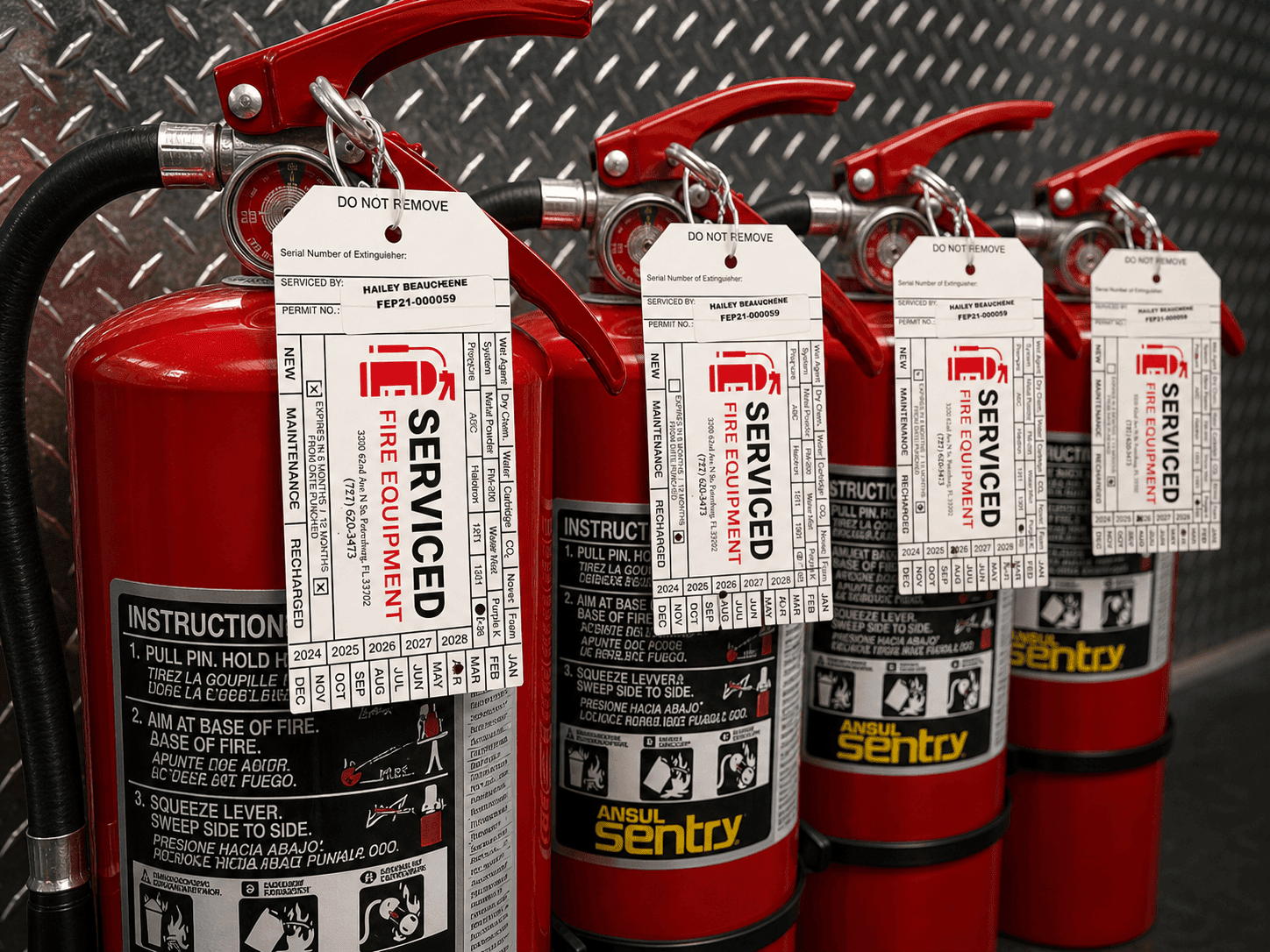
A current, signed inspection tag is required documentation under both OSHA 1910.157 and NFPA 10
Record Keeping and the Most Common 1910.157 Citations
Furthermore, OSHA citations under 1910.157 almost always fall into one of four categories. Understanding what inspectors actually look for is more useful than memorizing the full text of the standard.
Citation 1: Missing or outdated inspection tags
The most frequently cited violation. An extinguisher without a current annual inspection tag — dated within the past 12 months, signed by a licensed technician — is non-compliant. Tags that are present but illegible, missing a date, or missing a technician signature also generate citations. The fix is an annual inspection and certification by a qualified dealer.
Citation 2: No monthly inspection records
The monthly visual check is required and must be documented. Many facilities do the check informally but have no written record. A simple log — date, initials, unit ID — satisfies this requirement. Some facilities use a tag on the extinguisher with monthly check boxes; others maintain a separate digital or paper log. Either works; undocumented does not.
Citation 3: Extinguisher blocked or inaccessible
An extinguisher behind pallets, inside a locked room, blocked by equipment, or simply not visible to employees is cited as inaccessible regardless of its maintenance status. This is a physical compliance issue — the unit must be reachable and visible at all times. Seasonal storage changes and equipment rearrangement are common culprits.
Citation 4: No documented employee training
As covered above — training records are required, not just training. If an inspector asks and you cannot produce written evidence that employees received extinguisher training in the past 12 months, the citation follows. Annual training documentation is a simple paper or digital record that takes minutes to create and can prevent significant fines.
A note on OSHA fines: As of 2026, OSHA serious violations carry penalties up to $16,550 per violation. Willful or repeat violations can reach $165,514 per violation. A single OSHA inspection that finds four non-compliant extinguishers in a facility with missing tags, no monthly logs, and no training records can generate a penalty that dwarfs the cost of years of proper maintenance.
Our annual inspection service produces the dated, signed documentation that satisfies both the OSHA tag requirement and NFPA 10. We serve commercial accounts throughout Pinellas and Hillsborough counties from our St. Petersburg facility.
Frequently Asked Questions
Does OSHA 1910.157 apply to my business?
1910.157 applies to general industry employers — broadly, any business that is not construction, maritime, or agriculture. If you have a workplace where employees could encounter a fire, and those employees might use a fire extinguisher to fight or assist evacuation from that fire, the standard applies. The only exemption is an employer who has a documented total-evacuation policy and does not provide extinguishers — but most businesses that have extinguishers on the walls are covered, whether or not they have ever thought about it explicitly.
What is the difference between OSHA 1910.157 and NFPA 10?
OSHA 1910.157 is federal law that covers employer obligations — placement, inspection, maintenance, training, and documentation. NFPA 10 is a technical standard published by the National Fire Protection Association that specifies how extinguishers should be serviced and tested. OSHA incorporates NFPA 10 by reference for maintenance procedures, which means following NFPA 10 is a component of OSHA compliance. But OSHA adds training and documentation obligations that NFPA 10 does not address, and OSHA inspectors can cite you under 1910.157 for failures that NFPA 10 does not even cover.
How often must fire extinguishers be inspected under OSHA?
OSHA 1910.157 requires a monthly visual check (performed and documented by an employee) and an annual maintenance inspection (performed by a qualified person — in practice, a licensed technician). Through its reference to NFPA 10, it also requires 6-year internal maintenance and hydrostatic testing on the applicable interval for each extinguisher type. All of these are separate requirements, not alternatives to each other.
Can I do the OSHA monthly fire extinguisher check myself?
Yes — the monthly visual check under 1910.157(e)(1) can be performed by a designated employee, not a licensed technician. The employee checks that the unit is in its designated location, has not been actuated or damaged, and shows no obvious deficiency. The check must be documented with the date and inspector's initials. The annual maintenance inspection is a separate, more thorough requirement that does need to be performed by a qualified person.
What training do employees need under OSHA 1910.157?
Where employees are expected to use portable fire extinguishers, OSHA requires training in general principles of extinguisher use and the hazards of incipient-stage firefighting. This training must occur upon initial employment and annually thereafter. The training must be documented. Employers who designate specific employees as fire responders must provide more detailed hands-on training for those employees.
How far apart do fire extinguishers need to be under OSHA?
OSHA specifies maximum travel distances, not minimum spacing. For Class A hazards (ordinary combustibles), employees should not have to travel more than 75 feet to reach an extinguisher. For Class B hazards (flammable liquids), the maximum travel distance is 50 feet. These are OSHA's requirements; local fire codes and NFPA 10 may impose stricter placement rules, and whichever is more demanding controls.
Does OSHA 1910.157 apply in Florida, or does Florida law override it?
Florida does not operate a state OSHA plan for private-sector employers — federal OSHA applies directly. Florida Statute 633 and NFPA 10 apply through the state fire code. A Florida business is simultaneously subject to federal OSHA 1910.157, Florida fire code, and local AHJ requirements. When they overlap or conflict, the most stringent requirement governs. This is why commercial businesses in Florida must have extinguishers inspected by a licensed Florida dealer — state law requires it independently of what OSHA requires.
Get Your Facility Into Full Compliance
We service commercial accounts throughout Pinellas and Hillsborough counties. Annual inspection, 6-year internal maintenance, hydrostatic testing, and documentation that satisfies both OSHA 1910.157 and Florida Statute 633 — all in one walk-in visit, no appointment required.
St. Petersburg, FL 33702
Just off I-275
Business Hours
Walk-ins welcome
DOT Hydrostatic RIN D133
NAFED & FFEDA Member
Pricing Reference
(starting price)
(starting price)
(starting price)
RIN D133 authorized