What Is Hydrostatic Testing

Fire Extinguisher Maintenance Guide

What Is Hydrostatic Testing?

What hydrostatic testing is, why it is required, what happens during the test, which cylinders require it and when, what it costs, and what it means for your fire extinguisher compliance.

By Daniel Beauchesne, Florida State Fire Marshal Licensed Technician · License #EF-0001479 · DOT-Authorized Hydrostatic Testing Facility · RIN D133 · 25+ Years

The Short Answer

Hydrostatic testing is a pressure test performed on fire extinguisher cylinders to verify they can safely withstand operating pressure. The cylinder is filled with water, pressurized to a test pressure significantly above normal operating pressure, and inspected for expansion, leakage, and structural deformation. If the cylinder passes, it is recertified for continued service. If it fails, it is condemned and removed from service.

Hydrostatic testing is required by the U.S. Department of Transportation (DOT) under 49 CFR Part 180 for DOT-regulated compressed gas cylinders, and by NFPA 10 for fire extinguishers. Both regulations specify testing intervals by cylinder type — not by condition or appearance. A cylinder that looks perfectly fine from the outside can have internal corrosion, stress fractures, or wall thinning that only a pressure test reveals.

Only DOT-authorized facilities may perform hydrostatic testing on DOT-regulated cylinders. We are one of a limited number of fire equipment dealers in the Tampa Bay area — and in Florida — with DOT authorization to perform this work in-house. Our Requalification Identification Number is D133, valid through November 2027.

Who requires it

U.S. Department of Transportation (DOT) — 49 CFR Part 180 · NFPA 10 Standard for Portable Fire Extinguishers · OSHA 1910.157 · Florida Fire Code

Who can perform it

Only DOT-authorized independent inspection agencies (IIA) with a valid Requalification Identification Number (RIN). General fire equipment service companies without DOT authorization cannot legally perform this test on DOT-regulated cylinders.

Why Hydrostatic Testing Exists — and Why It Cannot Be Skipped

A fire extinguisher cylinder is a pressure vessel. Stored-pressure ABC units operate at approximately 195 psi. CO2 cylinders operate at approximately 850 psi at room temperature. High-pressure cylinders like SCBA tanks operate at 4,500 psi or higher. The structural integrity of these cylinders is not something that can be assessed visually — internal corrosion, pitting, stress cracking, and wall thickness reduction are invisible from the outside.

A cylinder that fails under operating pressure does not leak slowly. It fails catastrophically — the stored pressure releases explosively. A 10 lb CO2 extinguisher that fails under pressure has approximately the same kinetic energy as a small explosive device. This is why the testing interval is mandatory by regulation regardless of visible condition, and why only specifically authorized facilities are permitted to perform it.

The test interval is set by cylinder material and specification — not by how the extinguisher looks or how frequently it has been used. A cylinder that sits on a wall for twelve years and is never touched still requires hydrostatic testing at the required interval. Age and exposure are the variables that matter, not activity.

Real Talk

The most common thing I hear from business owners who have been using the same fire extinguishers for fifteen years: "It still has green on the gauge, it's fine." The gauge tells you the pressure is there. It tells you nothing about the condition of the cylinder wall that is holding that pressure. A CO2 unit that has never been discharged, never been dropped, and always read full weight can still have cylinder degradation that makes it dangerous to handle. That is what hydrostatic testing finds.

How Hydrostatic Testing Works

There are two accepted test methods under DOT regulations and NFPA 10: the water jacket method and the direct expansion method. Both apply water pressure to the interior of the cylinder and measure the cylinder's response.

Step 1 — Empty and disassemble

The extinguisher is fully discharged and disassembled. All extinguishing agent is removed, the valve assembly is removed, and the cylinder is cleaned internally. The internal surface is visually inspected for corrosion, pitting, dents, heat damage, and any evidence of previous damage or repair. Cylinders with visible internal damage may be condemned prior to testing.

Step 2 — Fill with water and pressurize

The cylinder is filled completely with water and pressurized to the test pressure specified on the cylinder nameplate — typically 5/3 of the service pressure for most extinguisher cylinders (approximately 166% of operating pressure). Water is used because it is nearly incompressible — if the cylinder fails, the water simply drops pressure rather than expanding explosively as a gas would.

Step 3 — Measure expansion

Under the water jacket method, the cylinder is placed inside a sealed jacket also filled with water. The amount of water displaced by the cylinder when pressurized (total expansion) and the amount that remains displaced after pressure is released (permanent expansion) are precisely measured. Permanent expansion beyond allowable limits — typically 10% of total expansion — indicates the cylinder has been permanently deformed and must be condemned.

Step 4 — Pass or condemn

A cylinder that passes — no leakage, no excessive permanent expansion, no visual failure — is stamped with the test date, the facility's RIN, and the tester's mark. It is then dried, reassembled with new valve components as needed, recharged, and returned to service. A cylinder that fails is rendered unusable: the DOT requires condemned cylinders to be rendered incapable of holding pressure, typically by drilling or crushing. They cannot be returned to service under any circumstances.
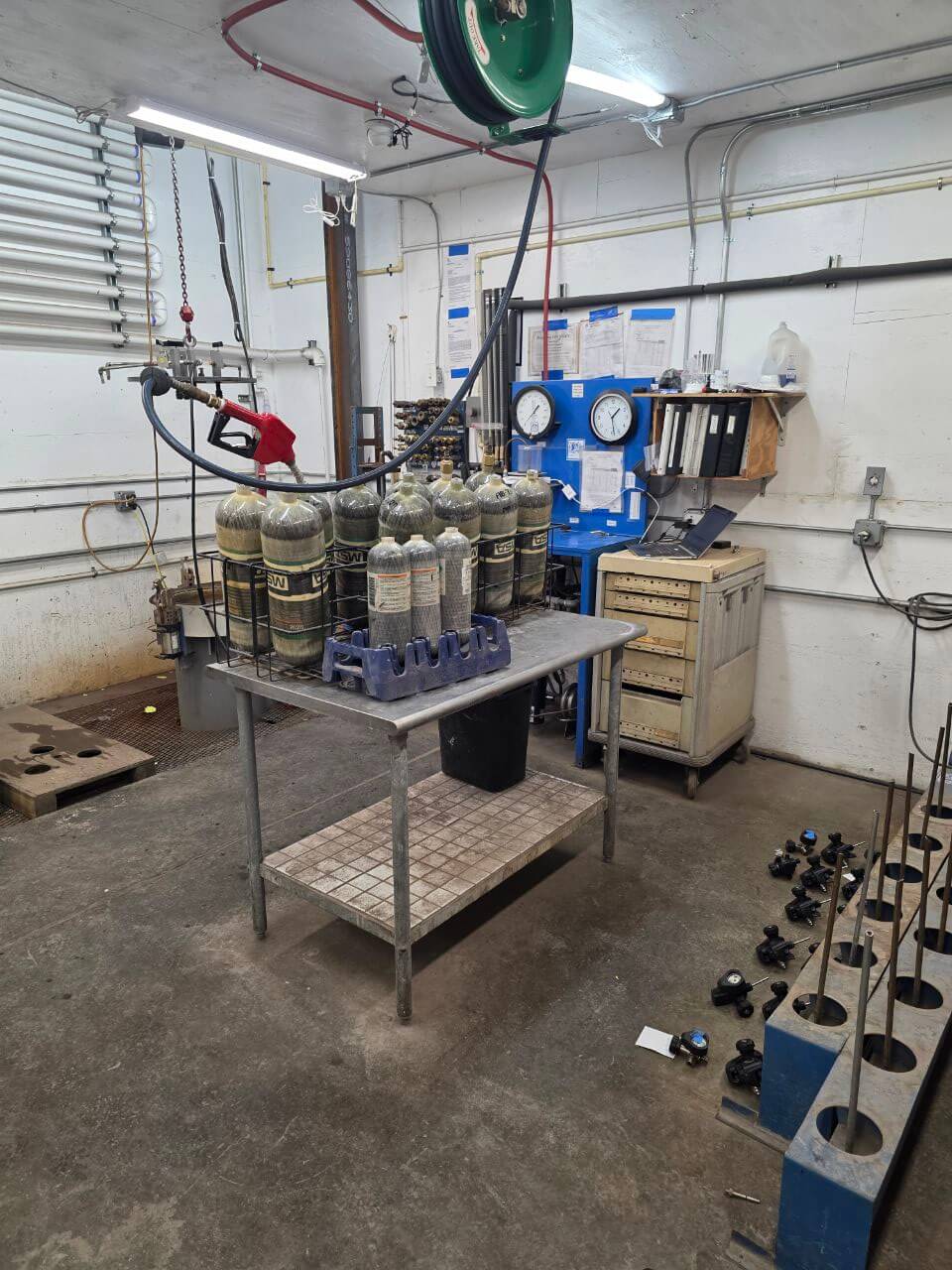
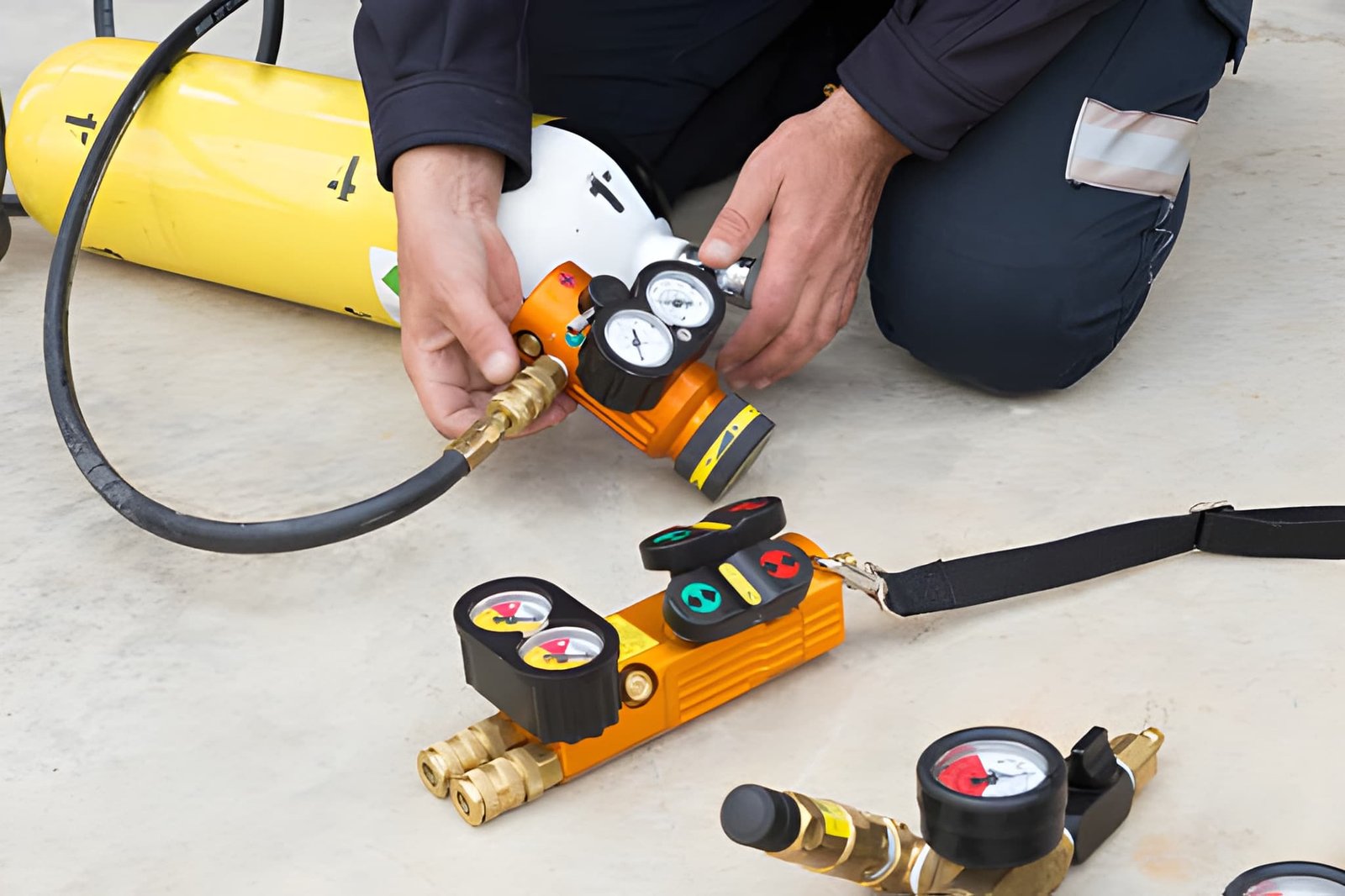
Hydrostatic testing of fire extinguisher cylinders DOT compliance hydrostatic testing requirements

Testing Intervals by Cylinder Type

The required testing interval depends on the type of cylinder and the extinguishing agent it contains. NFPA 10 Table 8.3.1 sets these intervals. The cylinder type is identified by the DOT specification stamped on the cylinder — not by the extinguisher model number or agent type alone.

Extinguisher Type Cylinder Spec Test Interval Notes
Stored pressure dry chemical (ABC, BC, Purple K) DOT 4B, 4BA, 4BW 12 years Most common commercial extinguishers. Date of manufacture stamped on cylinder.
Carbon dioxide (CO2) DOT 3A, 3AA, 3AL 5 years Higher operating pressure (~850 psi) requires more frequent testing. Most commonly missed interval in commercial facilities.
Wet chemical (Class K) DOT 4B, 4BA, 4BW 12 years Typically included in the recharge cost when due. We include hydrostatic testing in Class K recharge when the test is due.
Clean agent (Halotron, Cleanguard, FK-5-1-12) DOT 4B, 4BA, 4BW, 4BW240, 4BW500 12 years Same interval as stored pressure dry chemical. Verify cylinder spec on nameplate.
Water and water mist DOT 4B, 4BA, stainless steel 5 years More susceptible to internal corrosion due to water contact.
Nitrogen cylinders (wheeled unit propellant) DOT 3AA2015 5 years Separate from the agent cylinder on wheeled extinguishers. Both cylinders have independent test requirements.
SCBA air cylinders — steel or aluminum DOT 3AA, 3AL 5 years We perform SCBA hydrostatic testing in-house. Operating pressure up to 4,500 psi.
SCBA air cylinders — carbon fiber composite DOT 3HT 3 years or 15 years service life Composite cylinders have a mandatory retirement date regardless of condition. Both the 3-year test interval and the 15-year retirement apply — whichever comes first.
How to find the test date on your cylinder

The most recent hydrostatic test date is stamped directly into the metal of the cylinder — typically on the shoulder or neck. The stamp format is month/year followed by the tester's RIN (e.g., "03/19 D133" means tested in March 2019 by RIN D133). If you cannot locate a test date stamp, bring the unit in — we will assess it and advise.

What happens if no test date is visible

If a cylinder has no legible test date stamp, the original manufacture date on the nameplate becomes the reference point. A cylinder whose manufacture date exceeds the test interval with no visible test record is overdue and must be tested before returning to service. It is not compliant and should not be relied on.

DOT Authorization — Why It Matters and Why Most Dealers Don't Have It

Under 49 CFR Part 180, only DOT-authorized independent inspection agencies (IIA) may perform hydrostatic testing on DOT-regulated cylinders — which covers virtually every portable fire extinguisher and SCBA cylinder in commercial service. Authorization requires an application to PHMSA (Pipeline and Hazardous Materials Safety Administration), documented training, appropriate equipment, and ongoing compliance with federal inspection standards.

What DOT authorization requires
PHMSA application and approval process
Calibrated test equipment meeting federal specifications
Documented technician training per 49 CFR §172.704
Recordkeeping systems meeting federal standards
Periodic requalification and renewal
Assignment of a Requalification Identification Number (RIN) stamped on every tested cylinder
What non-authorized dealers do instead

Most fire equipment companies that service extinguishers do not have DOT authorization. When a cylinder comes due for hydrostatic testing they have two options: send it to a third-party testing facility (adding time and cost and breaking the chain of custody), or tell the customer to replace the unit rather than test it.

Neither is ideal. Sending to a third party means the cylinder leaves your facility, is tested by someone who has never seen the full maintenance history, and returns without the technician who will service it having been present for the test. Recommending replacement avoids the test entirely — which may be appropriate for very old cylinders but is not always the right answer.

Our DOT Authorization

We perform hydrostatic testing in-house at our St. Petersburg facility under DOT authorization issued by PHMSA. Our Requalification Identification Number is D133, valid through November 22, 2027. Every cylinder we test is stamped with this RIN and the test date. We maintain complete test records per federal requirements.

Download DOT Authorization Letter (PDF) →
DOT RIN
D133
Valid through Nov 2027

What Happens When a Cylinder Fails the Test

A failed cylinder is not a repaired cylinder. There is no fix for a cylinder that fails hydrostatic testing — it is condemned, rendered permanently inoperable, and replaced. Here is what that looks like in practice.

Grounds for condemnation before testing

Some cylinders are condemned on visual inspection before the pressure test even begins: fire damage or heat discoloration, dents or gouges that affect structural integrity, previous repairs using unapproved methods, missing or illegible manufacturer markings, bulging or deformation, pitting that exceeds allowable limits on internal or external inspection. These cylinders do not proceed to testing — they are removed from service immediately.

Grounds for condemnation at testing

During the pressure test itself: any visible leakage at test pressure, permanent volumetric expansion exceeding 10% of total expansion, failure to achieve or hold test pressure, any cracking, distortion, or bulging observed during pressurization. Any of these results in immediate condemnation.

What condemnation means

DOT requires condemned cylinders to be rendered permanently incapable of holding pressure — typically by completely removing the valve and cutting or crushing the cylinder. The condemned cylinder cannot be repaired, refilled, or returned to service under any circumstances. It is scrap metal. A replacement cylinder must be purchased.

What you should do with an overdue cylinder

Do not continue using a cylinder whose hydrostatic test is overdue. It is not compliant under NFPA 10 or OSHA 1910.157, and it is not safe. Bring it in for testing — if it passes, it goes back into service. If it fails, we will advise on replacement. Most cylinders that have been maintained properly and have not been exposed to damage or extreme environments pass testing even after many years.
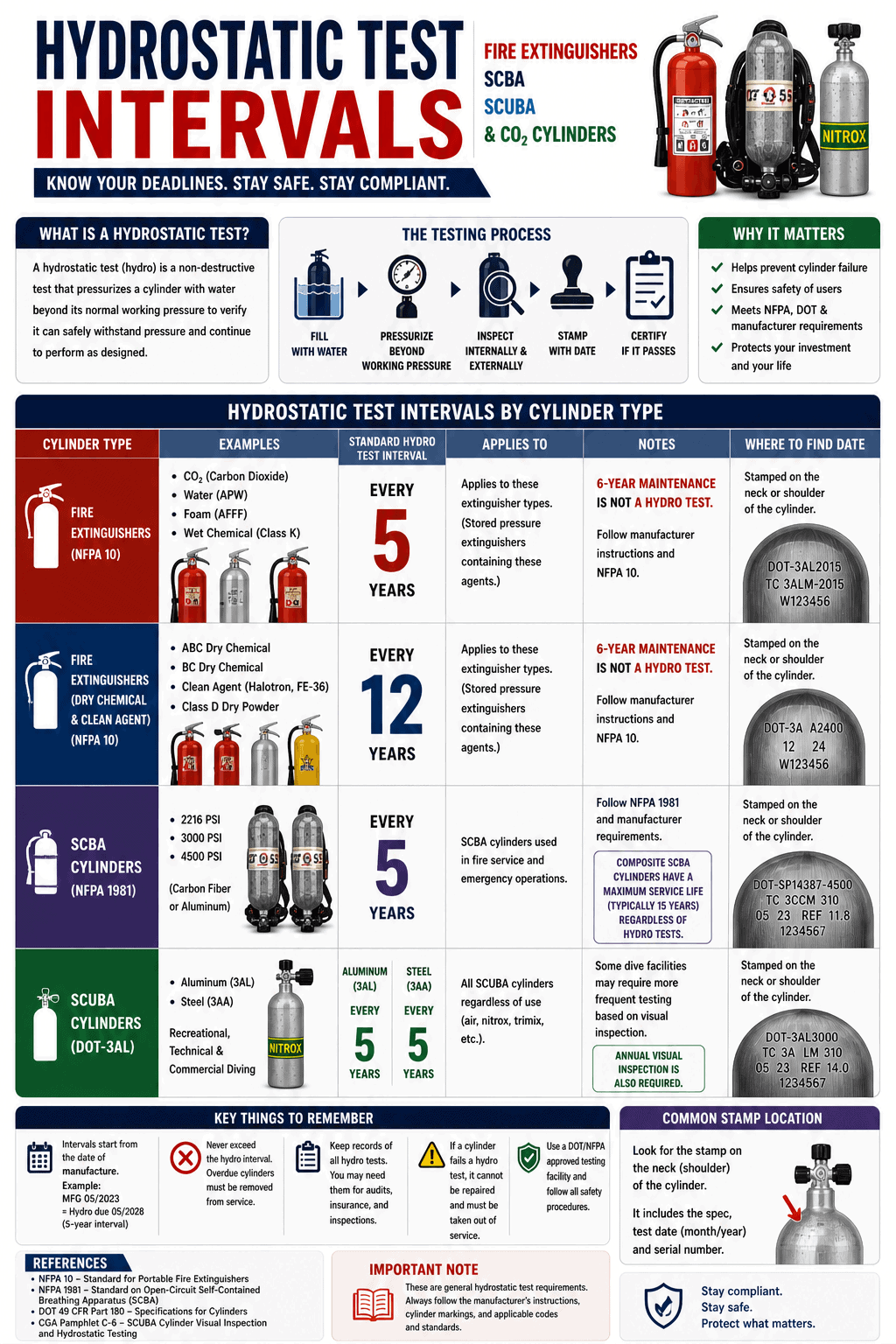
Hydrostatic testing intervals for fire extinguisher cylinders

Frequently Asked Questions

How do I know if my fire extinguisher needs hydrostatic testing?

Look at the test date stamped on the cylinder — typically on the shoulder or neck. The format is month/year followed by the tester's RIN (e.g., "06/13 D133"). For stored pressure dry chemical extinguishers, if the most recent stamp is more than 12 years ago the test is overdue. For CO2 extinguishers, the interval is 5 years. If you cannot locate a stamp or are unsure whether the date is current, bring the unit to our walk-in service — we will assess it at no charge.

How long does hydrostatic testing take?

Most extinguisher cylinders can be tested, reassembled, recharged, and returned the same day at our St. Petersburg facility. We perform testing in-house — there is no send-away to a third party and no extended turnaround. For wheeled units or SCBA cylinders, call ahead so we can confirm same-day availability.

Is it cheaper to just replace an extinguisher instead of testing it?

For small portable extinguishers — particularly 2.5 lb or 5 lb units approaching 12 years — replacement is sometimes the more economical choice when you factor in the cost of testing, recharge, and any parts needed. For larger units, CO2 cylinders, clean agent extinguishers, and especially wheeled units, testing and recharging is almost always significantly less expensive than replacement. We will give you a direct assessment when you bring the unit in.

Can any fire extinguisher company perform hydrostatic testing?

No. DOT authorization is required to perform hydrostatic testing on DOT-regulated cylinders, which covers virtually all fire extinguishers and SCBA cylinders in commercial service. A company without DOT authorization cannot legally perform this test and cannot stamp the cylinder with a valid RIN. If a facility claims to have performed hydrostatic testing but cannot provide a RIN or documentation, that testing is not valid for compliance purposes.

What is the difference between hydrostatic testing and the annual inspection?

Annual inspection is a visual and functional check — gauge pressure, tamper seal, label legibility, hose and nozzle condition, physical damage. It verifies the unit is ready to use but does not test the structural integrity of the cylinder itself. Hydrostatic testing is a destructive pressure test of the cylinder — it verifies the cylinder can safely hold and exceed its rated operating pressure. Both are required under NFPA 10 but on different schedules and for different purposes. The annual inspection tag on your extinguisher does not indicate the hydrostatic test has been performed — that is a separate stamp on the cylinder body.

Do you perform hydrostatic testing on SCBA cylinders?

Yes. We perform hydrostatic testing on SCBA cylinders — both steel/aluminum units (5-year interval) and carbon fiber composite units (3-year interval with 15-year service life). SCBA cylinders operate at up to 4,500 psi and are among the highest-priority cylinders for current testing. Bring them to our St. Petersburg facility. Our hydrostatic testing service page has full details on SCBA cylinder service.

DOT-Authorized · In-House · Same-Day Service

Hydrostatic Testing — Bring Your Cylinders In

We perform in-house hydrostatic testing under DOT authorization (RIN D133) — fire extinguishers, CO2 cylinders, SCBA tanks, and nitrogen cylinders. No send-away, no waiting. Most cylinders tested, recharged, and returned the same day.

Location
3200 62nd Ave N
St. Petersburg, FL 33702
Just off I-275
Hours
Monday – Friday
Business Hours
Walk-ins welcome
Phone
(727) 620-3473
Licensed since 1999
DOT Authorization
RIN D133
Valid through Nov 2027
Download Letter (PDF)

Serviced Fire Equipment Inc. · DOT-Authorized Hydrostatic Testing Facility · RIN D133 · Florida State Fire Marshal Class 01 & 04 · Licensed since 1999 · NFPA 10 · 49 CFR Part 180