Fire Safety — What to Do When It Matters
How to Use a Fire Extinguisher
The PASS method, when to fight and when to evacuate, what most people do wrong, and what your extinguisher needs before any of this applies.
By Daniel Beauchesne, Florida State Fire Marshal Licensed Technician · License #EF-0001479 · Class 01 & 04 · 25+ Years
Before You Do Anything: Two Questions
Most fire extinguisher training jumps straight to PASS. But the decision to use a fire extinguisher at all comes before technique. Get these two questions wrong and the method does not matter.
NFPA and OSHA both use the term "incipient stage" — a fire that is still in its early stages, roughly contained to the object or area where it started, and has not spread to surrounding materials or structures. If it is larger than a wastebasket, you are likely past incipient stage.
If the fire is growing, has spread to walls or ceilings, is producing heavy smoke that is filling the room, or involves flammable liquids spreading across a surface — evacuate. Do not fight it.
Never position yourself between the fire and your only exit. You fight toward the fire — meaning if the fire grows or the extinguisher runs out, you must be able to turn and leave without the fire blocking your path.
If you cannot confirm a clear exit path behind you before starting, do not start. Back out and evacuate.
Most people who were seriously injured trying to fight a fire with an extinguisher either chose to fight a fire that was already too large, ran out of agent before the fire was out, or did not have an exit path when things went wrong. The PASS method works. The judgment call of whether to use it at all is what saves lives.
The PASS Method — Step by Step
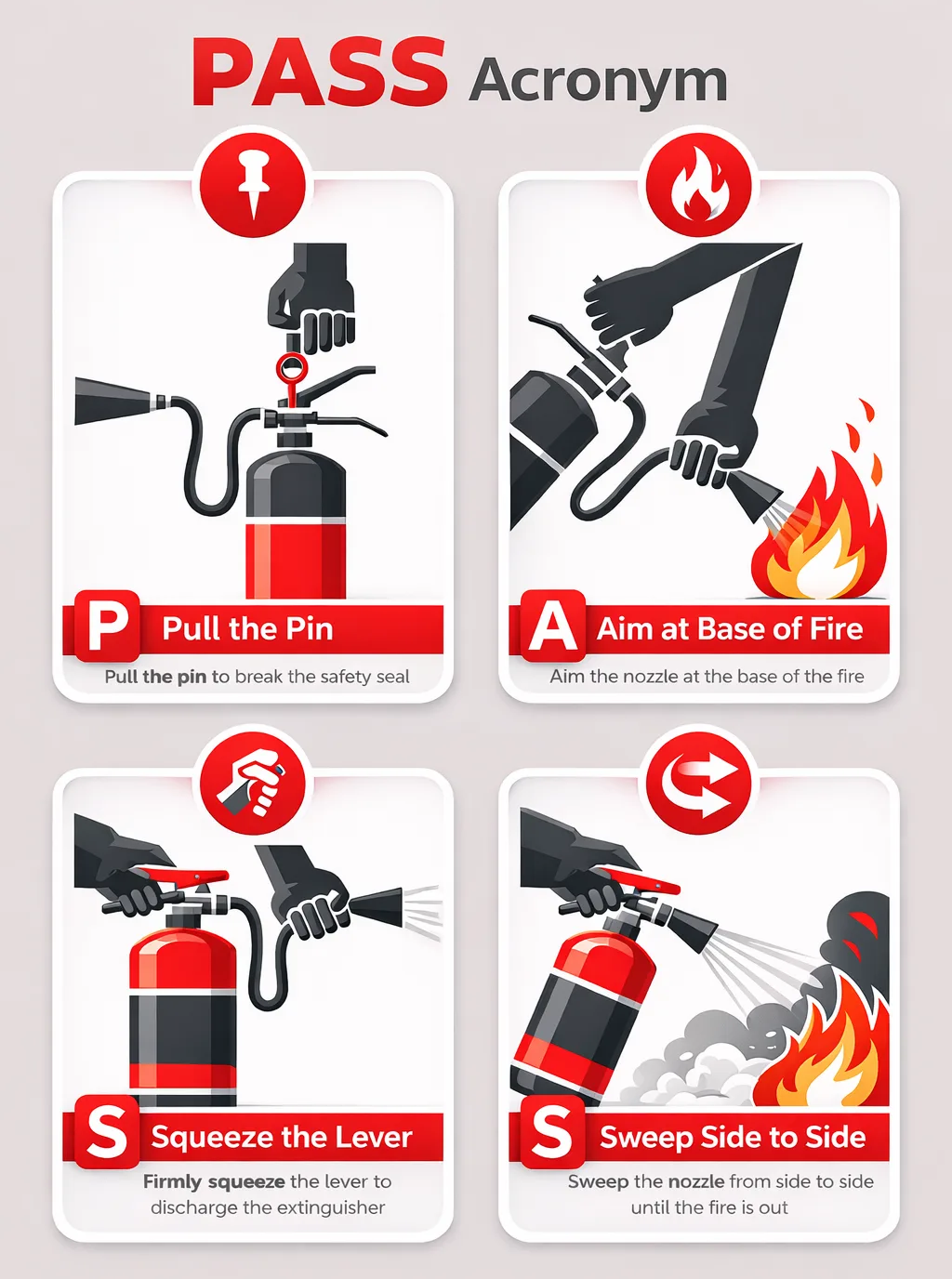
PASS is the universal operating procedure for portable fire extinguishers. Four steps, in order. The steps are simple — the details within each one are what separate effective use from ineffective use.
The pin is a tamper seal that prevents accidental discharge. It runs through the handle and valve. Pull it straight out — do not twist it. Some units have a plastic safety tie or wire seal around the pin; break or cut that first if present.
Once the pin is out, the extinguisher is live. The handle will activate the valve if squeezed. Keep your finger off the handle until you are aimed at the fire and ready to discharge.
This is the most critical step and the one people most often get wrong. Aim the nozzle or horn at the base of the fire — the point where the fuel is burning — not at the flames. The flames are a byproduct. The fire is sustained at the fuel surface. If you spray at the flames, you push the burning material around without suppressing combustion.
For CO2 units, hold the handle only — never grip the horn during discharge. The horn reaches temperatures of -110°F and will cause frostbite on contact.
Stand back far enough to keep the fire from reaching you if it flares, but close enough for the agent to reach the base. For most ABC dry chemical units, effective range is 8–15 feet. For CO2, effective range is only 3–8 feet — you need to be closer.
Squeeze the operating lever or handle firmly and evenly. Most extinguishers begin discharging immediately. Maintain steady pressure — do not pump the handle or release and re-squeeze repeatedly, as this wastes agent.
Be aware of how much agent you have. A standard 5 lb ABC extinguisher has approximately 8–12 seconds of discharge time. A 10 lb unit gives you roughly 10–20 seconds. Use it deliberately — do not spray wildly. Once the agent is gone, the extinguisher is empty regardless of whether the fire is out.
While squeezing, move the nozzle in a slow, controlled side-to-side sweeping motion across the base of the fire. This spreads the agent evenly across the fuel surface rather than concentrating it in one spot. Move from the near edge of the fire toward the far edge.
Continue sweeping even as the visible flames diminish. The fuel surface can still be hot enough to re-ignite after the flames are suppressed. Keep applying agent until the fire is fully out and you have used the available discharge time.
After discharge: back away slowly, keeping the extinguisher aimed at the fire area. Watch for re-ignition. Do not turn your back on the fire until you are certain it is out and the area has cooled. Even if the fire appears extinguished, evacuate and call the fire department — fire can reignite inside walls or in hidden material.
Pull · Aim · Squeeze · Sweep
When to Fight — and When to Get Out
OSHA 1910.157 and NFPA 10 both assume that fire extinguishers are for incipient-stage fires only. Understanding what that means in practice is the difference between a fire you can handle and one that will handle you.
Always call 911 regardless of whether you attempt to fight the fire. Even if you extinguish it, fire can reignite inside walls, in insulation, or in hidden fuel sources. The fire department needs to confirm the area is safe. This is not optional — it is standard protocol.
Match the Extinguisher to the Fire — This Is Not Optional
Using the wrong extinguisher type does not just fail to extinguish the fire — in some cases it actively makes it worse. The fire class determines which extinguisher to use. This is not a suggestion.
| Fire Class | What Burns | Use This | Never Use This |
|---|---|---|---|
| Class A | Wood, paper, fabric, plastics | ABC dry chemical, water | CO2 alone (re-ignition risk) |
| Class B | Flammable liquids — gasoline, oil, paint, solvents | ABC dry chemical, CO2, Purple K | Water — spreads burning liquid |
| Class C | Energized electrical equipment | ABC dry chemical, CO2, clean agent | Water — electrocution risk |
| Class D | Combustible metals — magnesium, titanium, lithium | Class D dry powder only | Water, ABC, CO2 — violent reaction risk |
| Class K | Cooking oils and fats — commercial kitchen fires | Class K wet chemical only | Water — explosive steam and splatter; ABC — re-ignition |
Cooking oil fires at high temperature are one of the most dangerous fire scenarios in a commercial kitchen. Water on a burning oil fire causes a violent steam explosion that turns the burning oil into a fireball. ABC dry chemical will suppress the flames but will not cool the oil — the fire reignites the moment the dry chemical settles. Only Class K wet chemical applies a saponifying agent that simultaneously cools the oil and chemically prevents re-ignition. If your kitchen does not have a Class K extinguisher and a properly serviced hood suppression system, it is not adequately protected.
The Most Common Mistakes When Using a Fire Extinguisher
Twenty-five years of servicing extinguishers and working with businesses on compliance means seeing what goes wrong in actual fire events — not just training scenarios. These are the errors that matter.
The single most common error. Flames are visible; the fuel surface is less dramatic to look at. Spraying at the orange is instinctive but wrong. The agent needs to reach the fuel — where the fire is being fed — not the combustion byproducts rising above it.
An extinguisher that was used once — even for a few seconds — and put back on the wall without recharging may have three seconds of agent left. It will not extinguish the fire. It will delay your evacuation. A used extinguisher that has not been recharged is not a fire extinguisher.
People instinctively back away from fire. At 20+ feet, the agent from a 5 lb ABC extinguisher has lost much of its velocity and concentration. Get within the effective range — 8–15 feet for ABC dry chemical, 3–8 feet for CO2. If you cannot get that close safely, the fire is too big to fight.
When the flames are out, the fire event is not over. Hot fuel surfaces, embers in wood or fabric, and burning material inside walls can all re-ignite. Back away slowly, watch the area, and do not assume success until the fire department has confirmed the area is clear.
Fighting a fire should never be a solo decision made quietly. Alert others, initiate evacuation for non-essential personnel, and ensure 911 has been called before you engage. If the fire grows beyond your ability to control it, you need an evacuation already underway — not one you have to start while retreating.
CO2 units discharge at -110°F at the horn. Grabbing the horn causes immediate frostbite. CO2 extinguishers are specifically designed with a swivel handle or grip that allows operation without touching the horn. This is a point that gets missed in training because it is not part of the PASS acronym itself.
After the Fire: What Needs to Happen Immediately
Once a fire event is over — whether you extinguished it or evacuated — there are immediate obligations on the equipment side that most businesses miss.
Any extinguisher that was discharged — even partially — must be recharged before it is returned to service. Under NFPA 10 and OSHA 1910.157, a discharged extinguisher on the wall is not a compliant extinguisher. It must be recharged and re-certified before it counts as operational. Our walk-in service handles this same day — no appointment needed.
A fire event — even a small one — may have exposed nearby extinguishers to heat, smoke, or physical impact. Any unit in the immediate area should be inspected before being relied upon. Heat damage to a cylinder is not always visible externally but can affect structural integrity.
For businesses subject to OSHA 1910.157, a fire event and the use of portable extinguishers should be documented. Record the date, the fire type, which extinguisher was used, the discharge duration, and any damage. This documentation supports your compliance record and may be relevant if insurance or liability questions arise.
A fire event often reveals gaps — an extinguisher that was too small for the hazard, a unit placed too far from the point of origin, or a type that did not match the fire class. Use the event as a reason to review your facility's placement and type selection against NFPA 10 requirements.
Frequently Asked Questions
PASS stands for Pull, Aim, Squeeze, Sweep. Pull the pin to arm the unit. Aim the nozzle at the base of the fire — not the flames. Squeeze the handle to discharge the agent. Sweep the nozzle side to side across the base of the fire until it is out or the agent is exhausted.
For ABC dry chemical, the effective range is approximately 8–15 feet depending on unit size. For CO2, effective range is only 3–8 feet — you need to be significantly closer. Start at the far end of the effective range and move closer as the fire diminishes if safe to do so. If you cannot get within effective range without putting yourself at risk, the fire is too large to fight with a portable extinguisher.
Discharge time depends on the size of the unit. A 2.5 lb ABC unit discharges in approximately 8 seconds. A 5 lb unit gives roughly 8–12 seconds. A 10 lb unit gives 10–20 seconds. A 20 lb unit may discharge for up to 25–30 seconds. This is shorter than most people expect — use the agent deliberately and do not waste it spraying the wrong part of the fire.
Pull the pin before you approach — but keep your finger off the trigger until you are within effective range and aimed at the base of the fire. Pulling the pin does not discharge the extinguisher; squeezing the handle does. Having the pin out means you are ready to discharge the moment you reach your position, without an extra step when seconds matter.
It depends on the mismatch. Water on a Class B flammable liquid fire spreads burning liquid. Water on a Class C electrical fire creates electrocution risk. Water on a Class D metal fire can cause a violent explosion. ABC powder on a Class K cooking oil fire will suppress the flame but allow re-ignition because it does not cool the oil. In all these cases, the wrong extinguisher makes the situation worse — sometimes dramatically so. Know what type of extinguisher you have and what it is rated for before a fire starts.
Yes — immediately. Any extinguisher that has been discharged, even partially, must be recharged before it is considered operational again. A unit with a green gauge that was briefly discharged may look fine but could have insufficient agent to fight another fire. Under NFPA 10 and OSHA 1910.157, a discharged unit that has not been recharged is not a compliant fire extinguisher. Bring it to us — recharge service starts at $25 for ABC and most walk-in visits are done in under 10 minutes.
Make Sure Your Extinguisher Will Actually Work
Knowing how to use an extinguisher is only half of it. The unit on your wall needs to be charged, inspected, and the right type for your hazard. Bring it in — we will check it on the spot. No appointment needed, most visits under 10 minutes.
Business Hours
Walk-ins welcome
Pricing Reference
(starting price)
(starting price)
(starting price)
no appointment needed
