
Fire Extinguisher Identification Guide
Fire Extinguisher Color Codes Explained
What the colors on a fire extinguisher actually mean — body color, label color, band color, and the fire class symbols — and why the US system differs from what you may have seen elsewhere.
By Daniel Beauchesne, Florida State Fire Marshal Licensed Technician · License 585272-0007-2005 · Class 01 & 04 · 25+ Years
The Short Answer
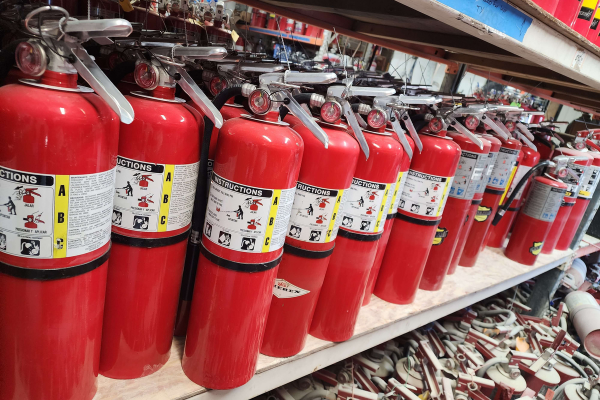
In the United States, fire extinguisher body color does not have a standardized meaning. Almost all portable fire extinguishers sold in the US are red — regardless of agent type. The agent type and fire class ratings are communicated through the label, not the body color.
This is the source of most of the confusion around this topic. People searching for "fire extinguisher color codes" have often seen color-coded charts — silver for CO2, cream for dry powder, blue for dry powder, red for water — but those charts describe the UK and European standard (BS EN 3), not the US standard. If you are in the United States, those color codes do not apply to the extinguishers on your walls.
What does matter in the US — and what NFPA 10 and UL certification require — is the information on the label: the agent name, the fire class ratings, the operating instructions, and the UL listing mark. Here is what each element means and how to read it correctly.
Almost all extinguishers are red regardless of agent. Agent type and fire class ratings are on the label. Fire class symbols (geometric shapes with letters) are the identification system.
All extinguishers are red body with a colored band indicating agent type: red = water, cream = foam, blue = dry powder, black = CO2, yellow = wet chemical. This color-band system does not apply in the US.
The US System: Fire Class Symbols on the Label
In the United States, you identify what fires an extinguisher can handle by reading the fire class symbols on its label — not by looking at the body color. These symbols are standardized by NFPA 10 and required on all UL-listed extinguishers. Each class uses a geometric shape, a letter, and a specific color.
Most fire extinguishers are rated for multiple classes. An ABC dry chemical unit carries all three symbols — green triangle, red square, and blue circle. A CO2 unit carries the red square and blue circle but not the green triangle. Read all the symbols on the label, not just one. The combination tells you the full coverage picture.
US Extinguisher Colors in Practice: What You Actually See
While body color is not standardized in the US, there are patterns that have become conventional over decades of manufacturing. Understanding these conventions helps you identify what you are looking at before you read the label — but always confirm by reading the label.
| What You See | Likely Agent Type | Fire Classes | Confirm by reading |
|---|---|---|---|
| Red cylinder, yellow/white label | ABC dry chemical (most common) | A, B, C | Label — "ABC" or "Multi-Purpose" |
| Red cylinder, black label | BC dry chemical (Purple K or standard BC) | B, C only | Label — "BC" or "Purple K" |
| Red cylinder, black horn (no gauge) | CO2 — carbon dioxide | B, C only | Label — "CO2" or "Carbon Dioxide." No pressure gauge is the giveaway. |
| Red cylinder, silver/chrome finish | CO2 (older or commercial units) | B, C only | Label — confirm CO2 agent |
| Red cylinder, silver label, smaller unit | Clean agent (Halotron, Cleanguard) | A, B, C | Label — agent name will specify Halotron, Cleanguard, or FK-5-1-12 |
| Stainless or chrome cylinder, no label color convention | Class K wet chemical (commercial kitchen) | K | Label — "Class K" or "Wet Chemical." Usually found in commercial kitchens only. |
| Yellow or natural aluminum cylinder | Class D dry powder (combustible metals) | D only | Label — "Class D" and the specific metal it is rated for |
These conventions are not mandatory — a manufacturer can legally produce a red ABC extinguisher and a red CO2 extinguisher that look nearly identical. The label is always the definitive source. The most reliable visual differentiator between ABC and CO2 is the absence of a pressure gauge on CO2 units and the presence of a black plastic or metal horn instead of a nozzle.
How to Read a US Fire Extinguisher Label
The label on a US fire extinguisher contains everything you need to know about what it can and cannot do. Here is what each section means.
A UL-listed extinguisher has been independently tested and certified to meet performance standards. The UL mark is not a government requirement, but it is required by most local fire codes and insurance carriers. If an extinguisher does not have a UL listing, it should not be relied on for compliance. Counterfeit extinguishers without proper UL listings do exist — particularly online — and may fail in use.
A typical label might read 3-A:40-B:C. Here is what that means:
3-A: The Class A rating. The number multiplied by 1.25 equals the approximate gallons of water needed to match the extinguishing effectiveness on a Class A fire. A 3-A rating is equivalent to roughly 3.75 gallons of water. Higher numbers indicate greater capacity.
40-B: The Class B rating. The number indicates the approximate square footage of a flammable liquid fire the unit can control. A 40-B rating means the unit can handle approximately 40 square feet of burning flammable liquid surface.
C: The Class C designation carries no number — it simply confirms the agent is non-conductive. There is no numeric measure of electrical fire capacity because the extinguisher does not fight electricity; it safely suppresses the fire without conducting current to the operator.
The label will state the actual extinguishing agent — "Monoammonium Phosphate," "Carbon Dioxide," "Potassium Bicarbonate," "Halotron I," "Cleanguard FK-5-1-12," or "Wet Chemical." This is what confirms the agent type regardless of body color. If you are choosing between recharging and replacing, the agent name tells you exactly what the unit contains and what it is certified for.
NFPA 10 requires that operating instructions be displayed on the label and remain legible at all times. A faded, peeled, or painted-over label is a citation item during annual inspection. The PASS method steps (Pull, Aim, Squeeze, Sweep) are typically illustrated with pictograms. The label must also show the maintenance date record area used by the technician during service.
Class ratings and agent labels are the identification system in the US — not body color
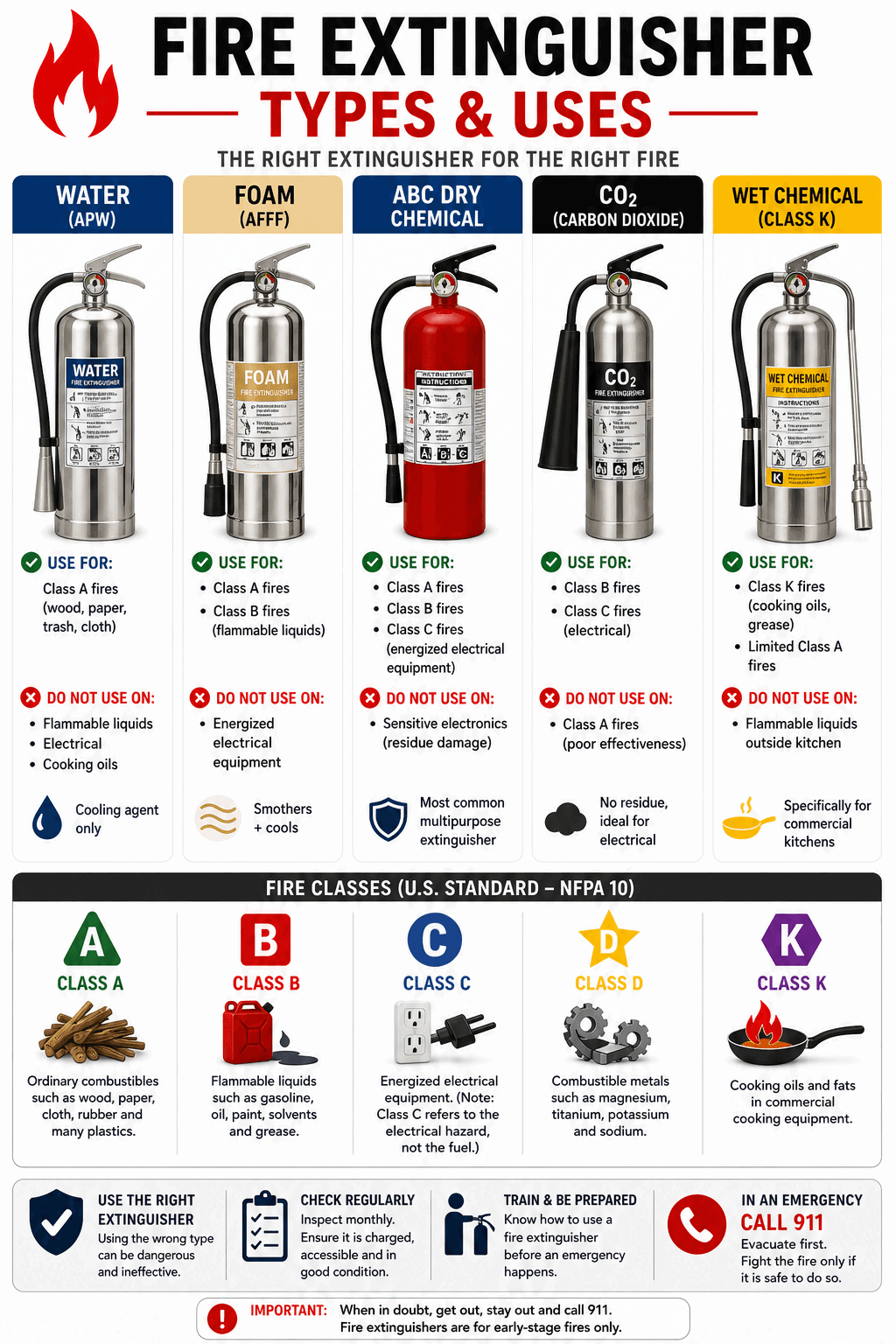
Every Common US Fire Extinguisher Type — At a Glance
A definitive reference for every portable extinguisher type you are likely to encounter in US commercial and residential settings.
Agent: Monoammonium phosphate · Classes: A, B, C · Body: Red
The most common commercial extinguisher. Widest fire coverage, moderate cost, corrosive residue after discharge. The standard choice for offices, warehouses, retail, and most general-purpose locations. Recharge starts at $25.
Agent: Potassium bicarbonate · Classes: B, C only · Body: Red
More effective than ABC on flammable liquid fires but no Class A coverage. Used in industrial settings, chemical plants, and fuel storage areas where Class A materials are not present. Purple K (potassium bicarbonate) is more effective pound-for-pound against Class B fires than monoammonium phosphate.
Agent: Carbon dioxide gas · Classes: B, C only · Body: Red, no gauge, black horn
Zero residue — the preferred choice for server rooms, electrical panels, labs, and sensitive equipment. Not rated for Class A. Hydrostatic testing required every 5 years. Recharge starts at $35.
Agent: Halotron I or FK-5-1-12 · Classes: A, B, C · Body: Red
Zero residue like CO2, but rated for Class A, B, and C. Does not displace oxygen. The premium choice for occupied spaces with sensitive equipment. More expensive to purchase and recharge. Learn more about clean agent extinguishers.
Agent: Potassium acetate solution · Class: K · Body: Stainless or red
Required in commercial kitchens. Suppresses cooking oil fires by saponification — creating a foam blanket that cools and smothers the oil and prevents re-ignition. Must accompany a properly serviced kitchen hood suppression system. Recharge starts at $195 including hydrostatic if due.
Agent: Metal-specific dry powder · Class: D only · Body: Yellow or natural aluminum
Rare in most commercial settings. Used in manufacturing, aerospace, laboratories, and military facilities where combustible metals are present. The agent is specific to the metal — a Class D extinguisher for magnesium fires may not be correct for a lithium fire. Never use water, ABC, or CO2 on a Class D fire.
The UK / European Color Code System (BS EN 3)
This section exists because most "fire extinguisher color code" charts that appear in search results and on safety websites describe the British Standard BS EN 3 system — not the US system. If you have seen a chart showing silver for CO2, cream for foam, or blue for dry powder, that chart describes the UK and European convention, not US practice.
The BS EN 3 system uses a color-coded band on a predominantly red body to identify the extinguishing agent. Here is that system for reference — but do not use it to identify extinguishers in the United States.
| Band Color (BS EN 3) | Agent Type | Fire Classes | Used In |
|---|---|---|---|
| Red (body only, no band) | Water | A | UK, Europe |
| Cream band | Foam (AFFF) | A, B | UK, Europe |
| Blue band | Dry powder (ABC equivalent) | A, B, C | UK, Europe |
| Black band | CO2 | B, C | UK, Europe |
| Yellow band | Wet chemical | A, F (cooking oils) | UK, Europe |
If you work in international facilities or manage equipment imported from Europe, confirm which standard applies to the specific units on site. A CO2 extinguisher purchased in the UK will have a black band on a red body. The same type of extinguisher purchased in the US will simply be red with no color band. Both are CO2 — the identification system is different, not the agent.
Frequently Asked Questions
Red became the convention in the US because it is universally associated with fire safety equipment — fire trucks, fire hydrants, alarm pull stations. When there is no regulatory requirement for body color to convey agent type, red becomes the default for visibility and recognition. The agent type information is conveyed through the label instead.
In the US, a silver or chrome-finish cylinder is commonly associated with CO2 extinguishers, particularly older commercial units. However, this is a convention rather than a requirement — read the label to confirm. In the UK, a silver finish can also indicate a water extinguisher. If you are in the US and see a silver unit, check for the absence of a pressure gauge and the presence of a black horn — those are the reliable CO2 identifiers.
The numbers indicate the relative extinguishing capacity for each rated class. For Class A, the number multiplied by 1.25 gives the equivalent gallons of water. A 4-A rating equals 5 gallons of water equivalency. For Class B, the number indicates the approximate square footage of flammable liquid surface fire the unit can control. Class C carries no number — it only confirms the agent is non-conductive.
The most reliable visual difference: CO2 units have no pressure gauge and discharge through a black plastic or metal horn. ABC stored-pressure units have a visible pressure gauge on top and discharge through a nozzle or hose with a nozzle. CO2 units also tend to feel heavier for their size because liquid CO2 is dense. When in doubt, read the label — the agent name is always stated.
In the US, body color itself is not part of the compliance inspection — the label is. What inspectors look for is a legible label with correct fire class ratings, a current inspection tag with date and technician signature, a gauge in the green zone, and physical condition of the cylinder and valve. A faded or illegible label is a citation item because the operating instructions must be readable. Color of the body is not on the inspection checklist.
Painting a fire extinguisher cylinder is not prohibited, but painting over the label is a violation — the label must remain legible at all times under NFPA 10. Any repainting must preserve the full label. More practically: painting a cylinder without proper preparation and using incorrect paint types can mask corrosion, cause paint-to-cylinder adhesion problems, or interfere with annual inspection of the cylinder body. If a unit needs cosmetic attention, a licensed technician should evaluate whether it is worth servicing or replacing. Bring it to our walk-in service and we will give you a direct assessment.
Not Sure What Type You Have?
Bring it in. We will identify the agent type, verify the fire class ratings, confirm whether it is in service condition, and tell you exactly what it needs. No appointment required — most visits under 10 minutes.
Business Hours
Walk-ins welcome
Pricing Reference
(starting price)
(starting price)
(starting price)
(hydro included if due)