
If you’re searching for fire extinguisher recharge service in St. Petersburg, FL, you have a clear best option: bring your unit to Serviced Fire Equipment, located right here in St. Pete. We’re a Florida State Fire Marshal-licensed fire equipment dealer offering walk-in recharge service with no appointment required and no service call fee. Most recharges are completed same-day. This guide covers everything you need to know about getting your fire extinguisher recharged in St. Petersburg — including when recharging is necessary, what the process involves, what it costs, and why walk-in service beats waiting for a service call.
When Does Your Fire Extinguisher Need to Be Recharged?
Importantly, a fire extinguisher must be recharged in three main situations: after any use (even partial discharge), when annual professional inspection reveals pressure below specifications, and after routine 6-year internal maintenance that requires complete agent replacement. Understanding each scenario helps you respond correctly when your extinguisher needs service.
After Any Use: This is the situation most people face at some point. If someone used the fire extinguisher — to put out a small kitchen fire, test it inadvertently, or respond to any fire incident — the unit must be recharged before being returned to service. Even a brief discharge lasting just a few seconds has depleted agent and may have affected pressure. Do not put a used extinguisher back on the wall without having it recharged. A discharged extinguisher on the wall creates a false sense of security — it looks ready but isn’t.
Low Pressure Discovered During Inspection: During monthly visual inspections, check the pressure gauge. If the needle has moved into the red “recharge” zone, the extinguisher has lost pressure and needs professional service. For CO₂ extinguishers, which require annual weighing rather than gauge reading, low weight means low agent charge and the unit needs recharging. For any extinguisher showing low pressure, bring it in promptly — every day it sits uncharged is a day your coverage is compromised.
Following 6-Year Internal Examination: When a stored-pressure dry chemical extinguisher undergoes its required 6-year internal examination, all agent is removed for inspection and the unit is refilled with fresh powder. This is technically a recharge as part of the larger service, performed by the licensed technician completing the 6-year exam.
What the Recharge Process Involves
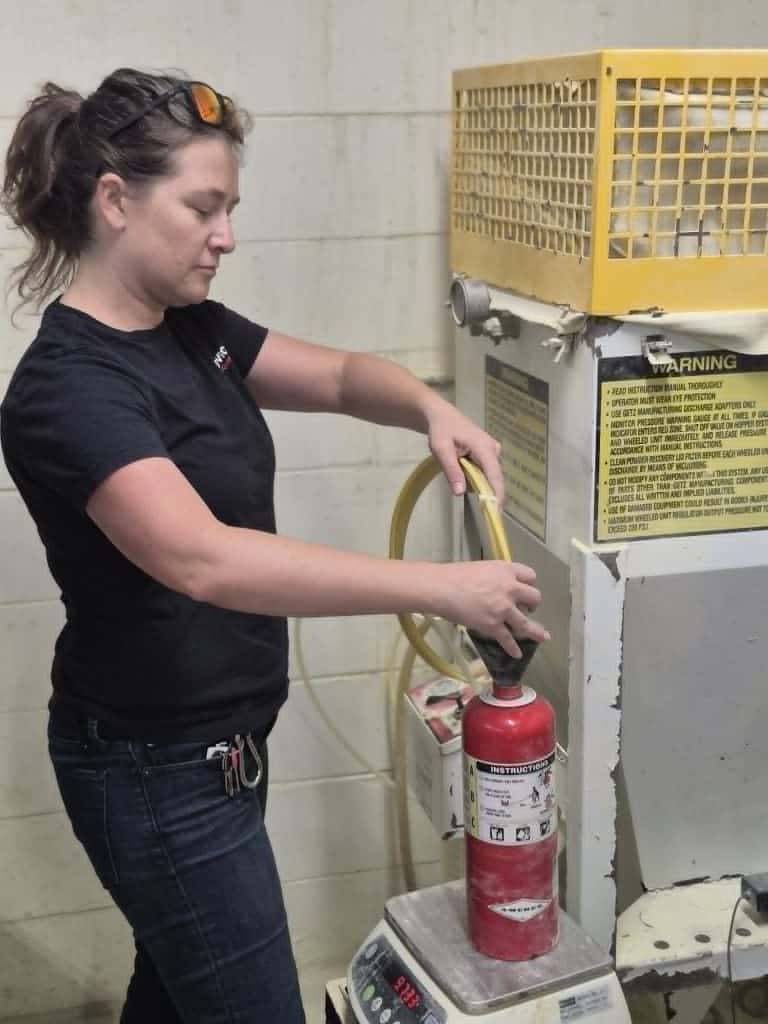
A proper fire extinguisher recharge is not just “topping it off.” It’s a complete service process that ensures the recharged unit is as reliable and compliant as a new one. At Serviced Fire Equipment, our recharge process includes:
First, complete inspection of the extinguisher to identify any issues beyond just agent depletion. Hose condition, nozzle condition, valve function, seal integrity, and cylinder condition are all checked. If we find additional issues — a cracked hose, a valve that doesn’t operate smoothly, a bent pull pin — we address them as part of the service rather than just recharging and returning a unit with underlying problems.
Second, valve disassembly and seal replacement. The O-ring and discharge valve seal are replaced with manufacturer-specified components. This step ensures that the recharged extinguisher won’t develop slow leaks from degraded seals — a common cause of extinguishers that show full pressure on the gauge one month and low pressure the next.
Third, fresh agent fill. We refill with the appropriate agent for your extinguisher type: monoammonium phosphate for ABC units, liquid CO₂ for CO₂ extinguishers, potassium acetate for Class K units, or the specific agent specified for any specialty type. Agent quality matters — we use UL-listed agents from authorized distributors.
Fourth, pressurization and leak test. After refilling, the unit is pressurized to the manufacturer-specified operating pressure using dry nitrogen, then inspected for leaks. Any pressure loss during the leak test means additional seal or valve work before the unit is certified.
Fifth, service tag. After successful completion of all steps, a new dated service tag is attached. For Florida compliance, our tags include our State Fire Marshal dealer license number and the technician’s name. This tag is your legal record of service.
How Much Does Fire Extinguisher Recharging Cost in St. Petersburg?
What’s more, recharging costs vary by extinguisher type and size. At Serviced Fire Equipment, our pricing is competitive with any licensed recharge service in the Tampa Bay area, and our walk-in model eliminates the service call fee that adds $75-150 to the cost at companies that charge for travel. Here’s a general pricing overview (contact us for specific current pricing):
ABC Dry Chemical: Recharging a 2.5 lb ABC extinguisher starts at around $15-20. A 10 lb ABC unit is typically $20-30. A 20 lb unit is $25-40. These are walk-in prices with no service call fee. Compare this to competitors who charge a $100+ service call fee before any service begins — our walk-in model represents genuine savings for businesses that can bring their units in.
CO₂ Extinguishers: CO₂ recharging is priced by the weight of CO₂ required. CO₂ is sold by the pound, and pricing varies with CO₂ market cost. Contact us for current CO₂ recharging pricing — we provide competitive rates for both fire extinguisher CO₂ recharging and beverage CO₂ refills.
Class K Wet Chemical: Class K recharging typically costs $30-60 depending on the unit size and agent quantity required. The proprietary wet chemical agents used in Class K units are more expensive than dry chemical powder, but the service remains competitive through our efficient walk-in service model.
Walk-In Service: No Appointment, No Service Call Fee
Beyond this, Serviced Fire Equipment’s walk-in service model is designed around the practical reality that most businesses can bring fire extinguishers to a shop more efficiently than scheduling a service technician to come to them. Consider the typical service call model: you call a competitor, they schedule a visit for sometime next week, a technician comes to your location for 15 minutes of actual service and charges you a $100-150 service call fee on top of the recharge cost. You’ve paid $125-175 for a $25 service.
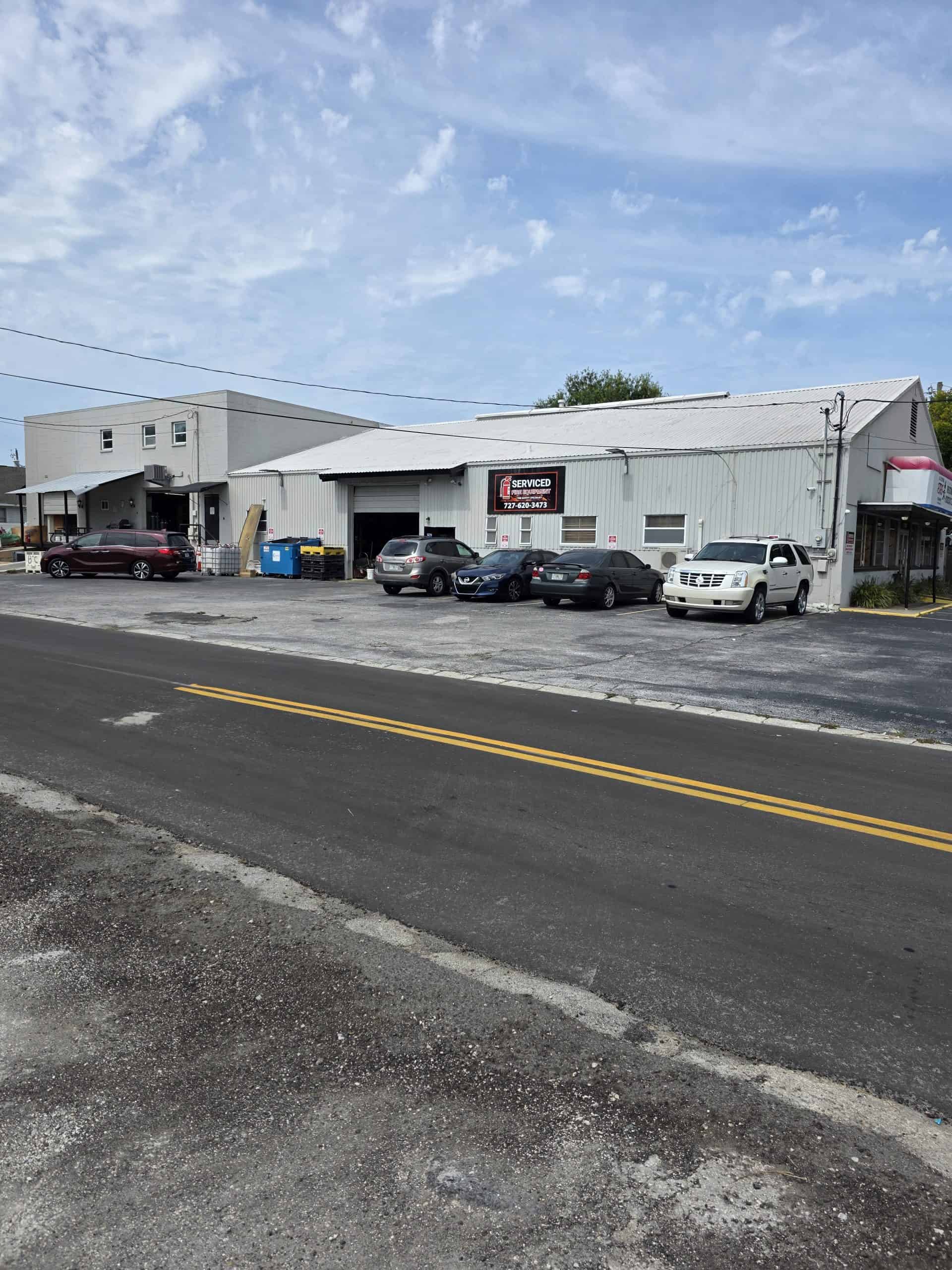
However, with our walk-in model, you drive to our St. Petersburg facility (we’re conveniently located for businesses throughout Pinellas County and accessible from Hillsborough County across the bay), hand over your extinguishers, we service them while you wait or run errands, and you pay only for the actual service. No service call fee, no scheduling delay, and — importantly — no waiting for your coverage to be restored. Most recharges are complete within 30-60 minutes.
For businesses with larger quantities of extinguishers, we can batch-process multiple units in a single visit. Call ahead when bringing more than 5 units so we can arrange efficient handling. We’ve serviced everything from a single kitchen extinguisher to full building inventories of 50+ units for property managers who drive from across the Tampa Bay area to save on service call fees.
Areas We Serve From St. Petersburg
Our St. Petersburg location is the convenient service destination for businesses throughout the entire Tampa Bay area. Our regular walk-in customers come from:
Tampa — a short drive across the Howard Frankland or Courtney Campbell bridges. Clearwater — about 25 minutes north on US-19. Largo — just a few miles from our location. Pinellas Park — 15 minutes away. Dunedin and Palm Harbor — 30-40 minutes up the coast. Brandon and Riverview — 35-45 minutes via the Selmon or I-4/I-75 corridors. Bradenton — accessible via Skyway Bridge or US-41. Sarasota — about an hour’s drive, still worth the trip for significant service orders that avoid service call fees. Pasco County and the Seminole area — also within practical driving distance.
Complete Fire Extinguisher Services Beyond Recharging
While many customers come to us specifically for recharging, we provide all fire extinguisher services at our St. Petersburg facility:
In particular, Annual Inspection and Certification — required every 12 months in Florida for all commercial extinguishers, performed by our State Fire Marshal-licensed technicians with compliant service tag documentation.
Hydrostatic Testing — DOT-certified pressure testing of fire extinguisher cylinders, SCUBA tanks, and SCBA cylinders at intervals specified by NFPA 10 and DOT regulations.
In most cases, 6-Year Internal Examination — complete disassembly, agent replacement, seal replacement, and cylinder interior inspection for stored-pressure dry chemical extinguishers.
Free Disposal — end-of-life extinguishers accepted for responsible disposal at no charge to the customer.
To put this in perspective, Refurbished Extinguisher Sales — certified refurbished units from Amerex, Ansul, and Buckeye at below-new pricing.
Beverage CO₂ Refills — for draft beer systems, restaurants, and homebrewers.
In other words, Visit our St. Petersburg facility or contact us today to get your fire extinguisher recharged and back in service.
Ready to get your extinguisher recharged?
Walk in today — no appointment needed. St. Petersburg's fire equipment specialists.
(727) 620-3473 — Call or Walk In3200 62nd Ave N, St. Petersburg, FL · Mon–Fri 8am–4pm
Need Your Extinguisher Recharged?
Walk in to our St. Petersburg facility — no appointment, no service call fee. Most recharges done in under 10 minutes.
CALL (727) 620-3473 — WALK-IN SERVICE3200 62nd Ave N, St. Petersburg, FL · Mon–Fri · From $25/unit