
Fire Extinguisher Service Life
How Long Does a Fire Extinguisher Last?
It depends on the type, the maintenance history, the manufacture date, and whether it has passed hydrostatic testing. Here is how to know exactly where yours stands.
By Daniel Beauchesne, Florida State Fire Marshal Licensed Technician · License #EF-0001479 · Class 01 & 04 · 25+ Years
The Short Answer
A well-maintained rechargeable fire extinguisher can last indefinitely — there is no hard expiration date built into the metal. A cheap disposable unit from a hardware store has a printed service life of 5 to 12 years and cannot be refilled when that window closes.
But "how long it lasts" is really four separate questions layered on top of each other. Most people only think about one of them — usually the gauge — and miss the other three entirely. That is how you end up with an extinguisher that looks fine, reads green, and will still fail when you need it.
In short, Here is the full picture:
Rechargeable vs. Disposable: The First Thing to Figure Out
Flip your extinguisher over and look at the bottom or the label. If it says "Non-Rechargeable" or "Discard After Use," you have a disposable unit. These are the lightweight aluminum-bodied extinguishers commonly sold at hardware stores and online. They are inexpensive, they work once, and then they are done.
Specifically, disposable extinguishers have a factory-set service life printed on the label — typically 5 to 12 years from the manufacture date stamped on the cylinder neck. Once you hit that date, or once the unit has been discharged for any reason, it must be replaced. You cannot recharge it. You cannot extend its life. You cannot certify it for commercial use.
In contrast, rechargeable extinguishers — the heavy steel-valve commercial-grade units used in virtually every business — are a completely different product. With proper annual inspections, 6-year internal maintenance, and passing hydrostatic test records, a rechargeable extinguisher has no theoretical end date. I have serviced ABC dry chemical units from the 1980s that are still in active service today because someone kept up with the maintenance schedule.
How Cylinder Condition Determines Service Life
Therefore, the extinguisher's service life is determined by the cylinder, not the calendar. And the cylinder's fate is determined by hydrostatic testing — not how old it looks.
In fact, most extinguishers I see walk through our door are not actually expired — they have just never been serviced. The manufacture date alone does not tell you much. What tells you something is the maintenance tag. If there is no tag, or the last date on it is more than 12 months ago, you do not actually know what you have.
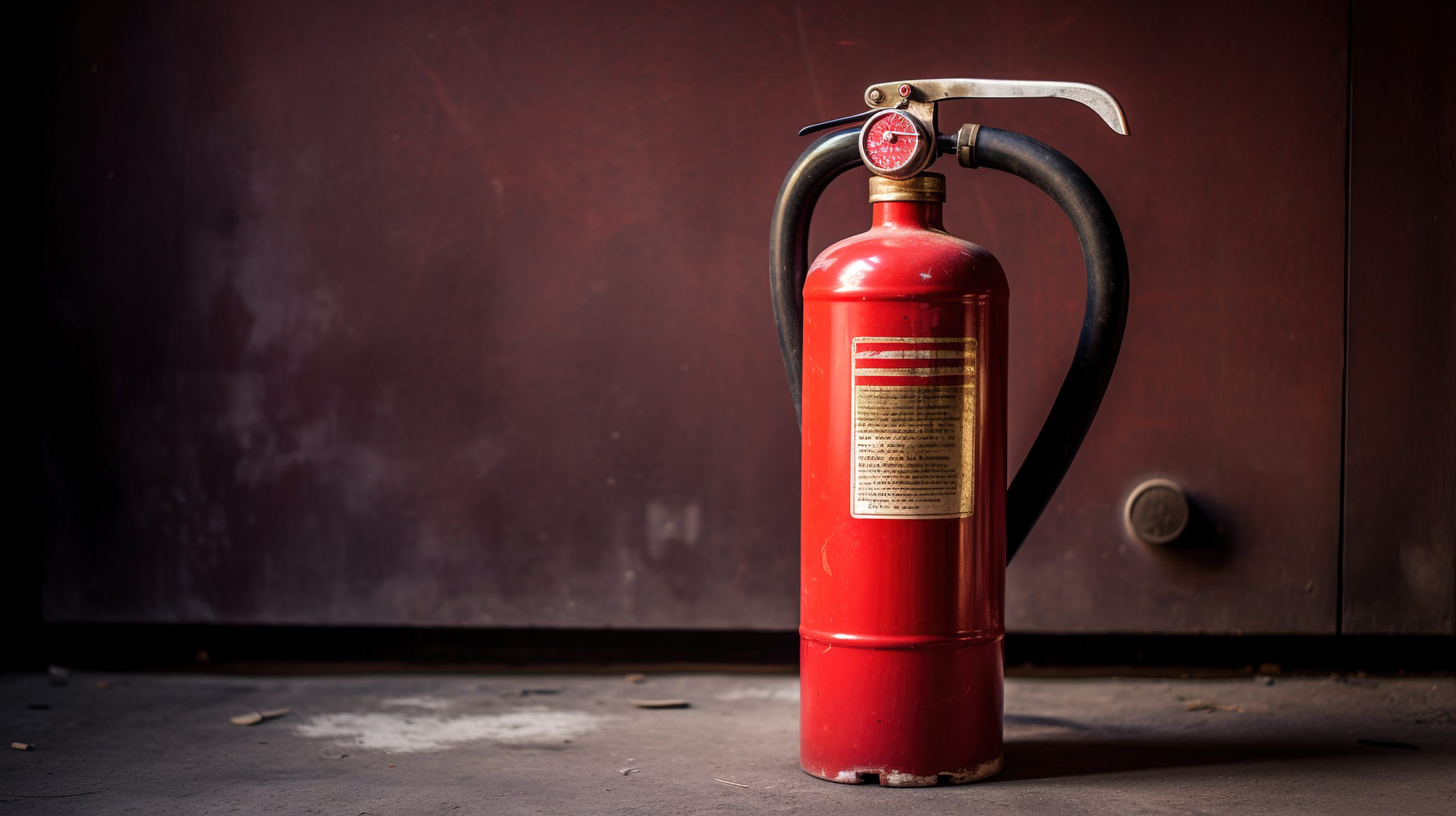
Rechargeable ABC extinguisher — serviceable indefinitely with proper maintenance
Frequently Asked Questions
Yes — for rechargeable units, the maintenance schedule runs on calendar years, not use. Specifically, an extinguisher mounted to a wall in 2010 and never touched still needed annual inspection every year, 6-year internal maintenance in 2016, and is now overdue for hydrostatic testing. "Never used" does not mean "still good." It means nobody checked. The internal components age, the dry chemical can compact, and the cylinder corrodes whether or not a fire ever happened nearby.
In general, most residential fire extinguishers are disposable units with a printed service life of 5 to 12 years. Check the label on yours — the manufacture date and service life window should both be visible. If the unit is past its printed date, or if the gauge is reading in the red, replace it. Some higher-end residential units are rechargeable and follow the same NFPA 10 maintenance schedule as commercial units — annual inspection, 6-year maintenance, and hydrostatic testing on the applicable interval.
Therefore, it depends entirely on the unit and its history. A 7-year-old commercial rechargeable ABC extinguisher that just needs an annual inspection and recharge is worth servicing — there is no reason to replace it. A 25-year-old unit with no service records, visible corrosion, and an overdue hydrostatic test may cost more to certify than it is worth. Bring it in and we will give you a straight assessment. We are not in the business of selling new extinguishers to people who do not need them.
Common Questions About Extinguisher Age and Condition
For example, CO2 extinguishers require annual inspection, 6-year internal maintenance, and hydrostatic testing every 5 years under NFPA 10. The 5-year hydrostatic interval is more frequent than stored-pressure dry chemical units because CO2 cylinders operate at significantly higher pressures — a standard 10 lb unit is charged to around 850 psi at room temperature. That elevated pressure is why cylinder integrity is tested more frequently. CO2 hydrostatic testing is performed in our in-house DOT-authorized facility.
As a result, the cylinder is condemned and must be removed from service permanently. It cannot be repaired, re-tested, or recertified. The valve body and hardware may be salvageable for use on a new replacement cylinder if they are in good condition, but the failed cylinder itself is scrap. On older units that have never been tested, hydrostatic failure is more common than people expect — internal corrosion that is invisible from the outside can make a cylinder structurally unsound well before any external sign appears.
Recharging and Service Life Questions
However, recharging restores the agent and pressure — it does not reset the hydrostatic test clock or the 6-year maintenance interval. A freshly recharged extinguisher still needs to pass hydrostatic testing on schedule and still needs internal maintenance at the 6-year mark. Recharging is one necessary layer of the maintenance schedule, not a substitute for the others.
Additionally, Class K wet chemical extinguishers are rechargeable and have no fixed service life — they last as long as the cylinder passes hydrostatic testing, which is required every 5 years. They also require annual inspection and 6-year internal maintenance. Class K service is more involved than dry chemical because the wet chemical agent must be carefully handled and refilled to exact specifications. Our Class K recharge starts at $195 and includes hydrostatic testing if it is due at the time of service.
The Maintenance Timeline That Determines Service Life
For rechargeable extinguishers, NFPA 10 establishes a layered maintenance schedule. Each layer runs on its own clock. Missing any one of them means you do not actually know whether your extinguisher will perform when it is needed.
Additionally, a licensed technician physically examines the extinguisher — pressure gauge reading, pull pin and tamper seal condition, nozzle and hose for obstruction or damage, label legibility, and visible corrosion or dents on the cylinder body. A dated, signed certification tag is attached to the unit. This is the baseline. Without it, you have no documented evidence that the extinguisher is operational.
In Florida, annual inspection by a licensed dealer is required by law for all commercial properties under Florida Statute 633. Furthermore, self-inspection by the business owner does not satisfy the statute. Our annual inspection starts at $8 per unit.
Six-Year Internal Maintenance
Specifically, the extinguisher is fully discharged, disassembled, and inspected internally. The valve, o-rings, dip tube, and all internal components are examined and replaced as needed. The agent is weighed or measured, inspected for caking or contamination, and the unit is recharged to the correct pressure with fresh agent.
Importantly, this is the service that most businesses miss. The outside of an extinguisher can look perfect while the valve internals are corroded and the dry chemical has compacted into a solid mass that will not discharge under pressure. Learn more about 6-year internal maintenance requirements under NFPA 10.
Hydrostatic Pressure Testing
Moreover, the cylinder is filled with water and pressurized to a test pressure significantly above its operating pressure to verify the vessel wall can safely contain the stored charge without permanent deformation or failure. This is the only test that actually tells you whether the cylinder is structurally sound. A gauge in the green tells you nothing about cylinder integrity.
For example, CO2, water-type, and wet chemical cylinders require testing every 5 years. Stored-pressure dry chemical and clean agent cylinders require it every 12 years. The test date is stamped on a metal collar near the cylinder neck.
As a result, hydrostatic testing must be performed by a DOT-authorized facility. Serviced Fire Equipment holds DOT authorization for hydrostatic testing (RIN D133) — one of relatively few facilities in the Tampa Bay area with this certification in-house.
Therefore, a fire extinguisher that has been discharged — even for a second, even to test it — must be recharged before it is considered operational again. This is one of the most common compliance failures we see at walk-in. Someone used an extinguisher on a small grease fire, it mostly worked, they put it back on the bracket, and now it is sitting on the wall with a few seconds of agent left and a gauge still reading green because stored-pressure units do not always drop pressure noticeably after a short discharge.
ABC dry chemical recharge starts at $25. See our full recharge service — most walk-in visits are completed in under 10 minutes.
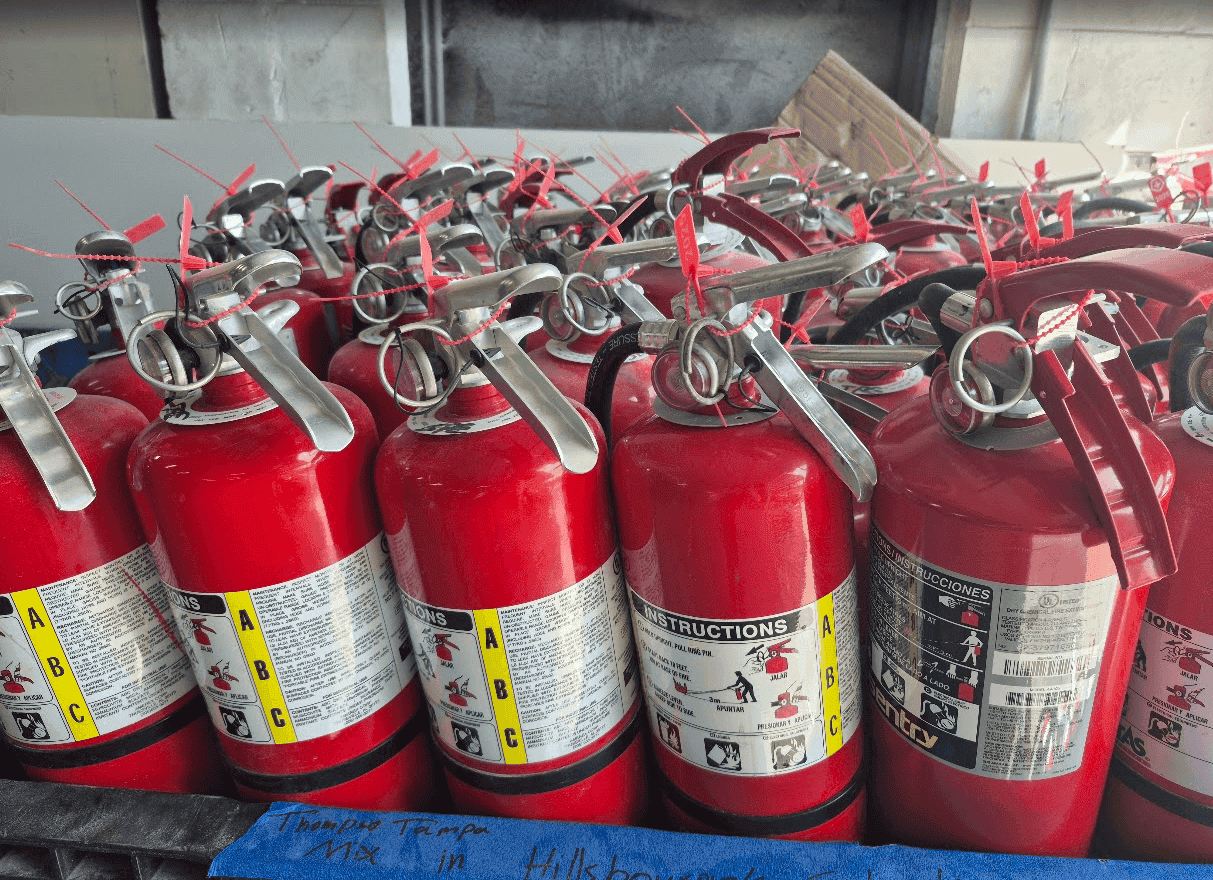
Ready-to-swap units in stock for walk-in customers — same day, no wait
When Does a Fire Extinguisher Need to Be Replaced?
Generally, A rechargeable extinguisher does not have an expiration date — it has pass/fail conditions. When any of the following are true, the unit is done:
How to Tell Where Your Extinguisher Stands Right Now
You do not need a technician to do a preliminary assessment. Pull the extinguisher off the wall and work through these four checks in order. They will tell you whether you need service and how urgently.
Specifically, there should be a hang tag or sticker near the bottom of the cylinder showing the date of the last annual inspection and the technician's license number. If there is no tag, or the most recent date is more than 12 months ago, the unit is overdue for its annual inspection and certification. If the tag is completely blank, it may have never been properly inspected at all.
Additionally, look for a date stamped into the cylinder neck or printed on the label. This is your baseline for calculating when the hydrostatic test is due and, for disposable units, when the unit must be replaced. If the manufacture date is more than 12 years ago on a dry chemical unit, or more than 5 years ago on a CO2 or wet chemical unit, and you have no hydrostatic test record on file, that is the first thing to address.
Checking the Hydrostatic Test and Pressure Gauge
Furthermore, hydrostatic test dates are stamped on a metal collar near the cylinder neck or recorded on service documentation kept with the unit. If you cannot find a test date — and the unit is old enough that one should have been done — it is overdue. Bring it in. Hydrostatic testing must be done by a DOT-authorized facility; we perform it in-house.
Moreover, the needle should sit in the green zone. In the red on either side — too low or too high — means service is needed immediately. A green reading means pressure is present. It does not mean the agent is good, the cylinder is safe, or the internal components are functional. The gauge is a starting point, not a clean bill of health. An annual inspection verifies everything the gauge cannot.
If you are in the Tampa Bay area and you have pulled your extinguisher off the wall and are not sure what you are looking at — bring it in. Our walk-in service requires no appointment. Most visits are done in under 10 minutes. We will tell you exactly what the unit needs, what it costs, and whether it is worth keeping. We are not going to sell you a new extinguisher if yours is serviceable.
Frequently Asked Questions
Yes — for rechargeable units, the maintenance schedule runs on calendar years, not use. Specifically, an extinguisher mounted to a wall in 2010 and never touched still needed annual inspection every year, 6-year internal maintenance in 2016, and is now overdue for hydrostatic testing. "Never used" does not mean "still good." It means nobody checked. The internal components age, the dry chemical can compact, and the cylinder corrodes whether or not a fire ever happened nearby.
In general, most residential fire extinguishers are disposable units with a printed service life of 5 to 12 years. Check the label on yours — the manufacture date and service life window should both be visible. If the unit is past its printed date, or if the gauge is reading in the red, replace it. Some higher-end residential units are rechargeable and follow the same NFPA 10 maintenance schedule as commercial units — annual inspection, 6-year maintenance, and hydrostatic testing on the applicable interval.
Therefore, it depends entirely on the unit and its history. A 7-year-old commercial rechargeable ABC extinguisher that just needs an annual inspection and recharge is worth servicing — there is no reason to replace it. A 25-year-old unit with no service records, visible corrosion, and an overdue hydrostatic test may cost more to certify than it is worth. Bring it in and we will give you a straight assessment. We are not in the business of selling new extinguishers to people who do not need them.
Common Questions About Extinguisher Age and Condition
For example, CO2 extinguishers require annual inspection, 6-year internal maintenance, and hydrostatic testing every 5 years under NFPA 10. The 5-year hydrostatic interval is more frequent than stored-pressure dry chemical units because CO2 cylinders operate at significantly higher pressures — a standard 10 lb unit is charged to around 850 psi at room temperature. That elevated pressure is why cylinder integrity is tested more frequently. CO2 hydrostatic testing is performed in our in-house DOT-authorized facility.
As a result, the cylinder is condemned and must be removed from service permanently. It cannot be repaired, re-tested, or recertified. The valve body and hardware may be salvageable for use on a new replacement cylinder if they are in good condition, but the failed cylinder itself is scrap. On older units that have never been tested, hydrostatic failure is more common than people expect — internal corrosion that is invisible from the outside can make a cylinder structurally unsound well before any external sign appears.
Recharging and Service Life Questions
However, recharging restores the agent and pressure — it does not reset the hydrostatic test clock or the 6-year maintenance interval. A freshly recharged extinguisher still needs to pass hydrostatic testing on schedule and still needs internal maintenance at the 6-year mark. Recharging is one necessary layer of the maintenance schedule, not a substitute for the others.
Additionally, Class K wet chemical extinguishers are rechargeable and have no fixed service life — they last as long as the cylinder passes hydrostatic testing, which is required every 5 years. They also require annual inspection and 6-year internal maintenance. Class K service is more involved than dry chemical because the wet chemical agent must be carefully handled and refilled to exact specifications. Our Class K recharge starts at $195 and includes hydrostatic testing if it is due at the time of service.
Not Sure Where Your Extinguisher Stands?
In short, bring it in. We will inspect it on the spot — no appointment needed. Most walk-in visits take under 10 minutes. We will tell you exactly what it needs, what it will cost, and whether it is worth keeping.
Business Hours
Walk-ins welcome, no appointment
Pricing Reference
(starting price)
(starting price)
(starting price)
(includes hydro if due)
