
Fire Extinguisher Requirements for Construction Sites in Florida
Construction sites are among the most complex and dynamic fire hazard environments that OSHA and Florida fire safety regulations address. Unlike a finished commercial building with fixed hazard zones and permanent fire protection infrastructure, a construction site changes daily. New combustible materials arrive and new work operations create new ignition sources. The site layout shifts constantly as construction progresses. Managing fire extinguisher compliance in this environment requires understanding federal OSHA requirements. Florida adds specific regulations that apply to all construction work in the state.
This guide provides a complete, practical breakdown of fire extinguisher requirements for construction sites, covering OSHA mandates. Florida code specifics, placement rules, inspection requirements, the types and ratings needed, and cost-effective sourcing strategies for contractors of all sizes.
The Primary Federal Standard: OSHA 29 CFR 1926.150
The federal OSHA Construction Standards, specifically 29 CFR 1926.150, establish the minimum fire protection requirements for construction sites. This standard has the force of law for all construction work performed in the United States, including in Florida. The key provisions are:
General Fire Extinguisher Requirement: A fire extinguisher rated no less than 2-A must be provided at each floor of a multi-story building under construction. For buildings over two stories, the extinguisher on the floor directly below the work floor must be rated at least 2-A:10-B:C. This two-floor rule ensures that workers always have fire protection within reasonable reach even when active construction is happening above.
Area Coverage Rule: One 2-A-rated fire extinguisher must be provided for each 3,000 square feet of protected building area or major fraction thereof. For a large floor plate. Say a 30,000 square foot commercial building floor. This means at least 10 extinguishers must be present on that floor. The square footage requirement ensures that fire protection is distributed throughout the work area rather than concentrated at a few central locations.
Travel Distance Rule: No point in the protected area should be more than 100 feet from an extinguisher. For vehicles and outdoor areas, the limit drops to 50 feet. This travel distance requirement is the practical spacing rule. If you know your site layout, you can calculate the minimum number of extinguisher locations needed to satisfy 100-foot travel distance from every point.
Flammable Liquid Areas: Wherever flammable or combustible liquids are stored or used. Fuel storage areas, solvent staging, painting operations. Additional fire extinguishers rated at least 10-B:C must be located within 50 feet of the hazard. ABC extinguishers rated 10-B:C or higher satisfy this requirement.
Open Flame and Welding Operations: At each location where open flame work (welding, cutting, torching) is performed, at least one fire extinguisher rated 2-A:10-B:C or higher must be immediately available at the work location.
Florida-Specific Requirements
Moreover, Florida’s Fire Prevention Code adopts OSHA’s requirements and adds state-specific provisions administered by the Florida State Fire Marshal. Key Florida additions for construction sites:
Annual professional inspection of all fire extinguishers by a licensed fire equipment dealer (Florida State Fire Marshal certification required) is mandatory, even for construction site units. OSHA’s monthly inspection by the contractor is in addition to. Not instead of. Florida’s annual professional inspection requirement. Florida contractors have a dual inspection obligation. The first part is monthly self-inspection per OSHA, and annual professional inspection per Florida fire code.
In addition, Florida also applies the local authority having jurisdiction (AHJ) requirements from local fire departments and county fire safety offices to construction sites. Some Florida counties have adopted additional requirements beyond state and federal minimums, particularly for high-rise construction or projects in fire-sensitive areas. Check with your local county fire safety office for any local amendments before setting up fire protection for a major project.
How to Calculate How Many Extinguishers You Need
Let’s walk through the calculation for a typical commercial construction project to illustrate how these rules translate to actual extinguisher counts:
What’s more, Example: A 3-story commercial office building with 25,000 square feet per floor, actively constructing the second and third floors with the first floor completed. Welding operations are active on the second floor. Fuel and solvents are stored in a designated staging area at the southeast corner of the site.
First floor (completed): 25,000 sq ft ÷ 3,000 sq ft = 8.33, rounded up = 9 extinguishers (2-A:10-B:C minimum) placed to satisfy 100-foot travel distance. Second floor (active construction): same calculation = 9 extinguishers; welding location requires 1 additional extinguisher immediately at the welding station; adjacent to first floor below = at least 2-A:10-B:C on the floor directly below the active work floor (already satisfied by the first-floor units). Third floor: same calculation. Site fuel storage area: at least one 10-B:C rated unit within 50 feet of the storage location.
Total for this project: approximately 27-30 extinguishers throughout the building plus site-level units for outdoor hazards. This is a realistic number for a mid-size commercial construction project in Florida, and it illustrates why contractors who need to outfit large projects benefit from cost-effective sourcing through certified refurbished extinguisher supply.
What Types and Ratings Are Required
Beyond this, The baseline requirement — 2-A:10-B:C. Is the standard ABC extinguisher specification for general construction areas. This covers Class A hazards (wood, paper, temporary materials), Class B hazards (flammable liquids at normal levels). Class C hazards (electrical equipment). For most of the job site, 5 lb or 10 lb ABC extinguishers rated 2-A:10-B:C or higher are the standard choice.
For areas with higher Class B hazard levels (fuel storage, painting, solvent cleaning), units rated at least 10-B:C belongs near those hazards. A 10 lb ABC unit typically provides 4-A:60-B:C, satisfying both the general and flammable-liquid proximity requirements. For welding stations, the same 2-A:10-B:C minimum applies, though some contractors keep larger units (20 lb ABC) at welding locations as an additional margin of protection given the direct ignition risk of hot work.
However, CO₂ extinguishers or dry BC units may be appropriate at electrical panels and generator stations where the Class C concern is primary and Class A materials are minimal. But most construction sites default to ABC units for simplicity and coverage breadth.
Monthly Inspection Requirements on Construction Sites
OSHA requires monthly inspection of all fire extinguishers on construction sites. Monthly inspections on a construction site are more critical than in a fixed building because: extinguishers get knocked over, partially discharged in small incidents. Buried under materials, or moved from their designated locations far more frequently on active construction sites. What passes monthly inspection in an office building should be verified weekly on an active construction site.
Critically, Monthly inspection documentation for construction sites should record: location of each extinguisher (a site map with marked extinguisher locations is helpful), extinguisher serial number or identifier, inspection date. Inspector name, gauge reading, tamper seal status, and any issues observed. This documentation must be available for OSHA inspection when requested. OSHA inspectors visiting construction sites look for fire extinguisher compliance and documentation as part of standard site safety reviews.
Sourcing Cost-Effective Construction Site Extinguishers
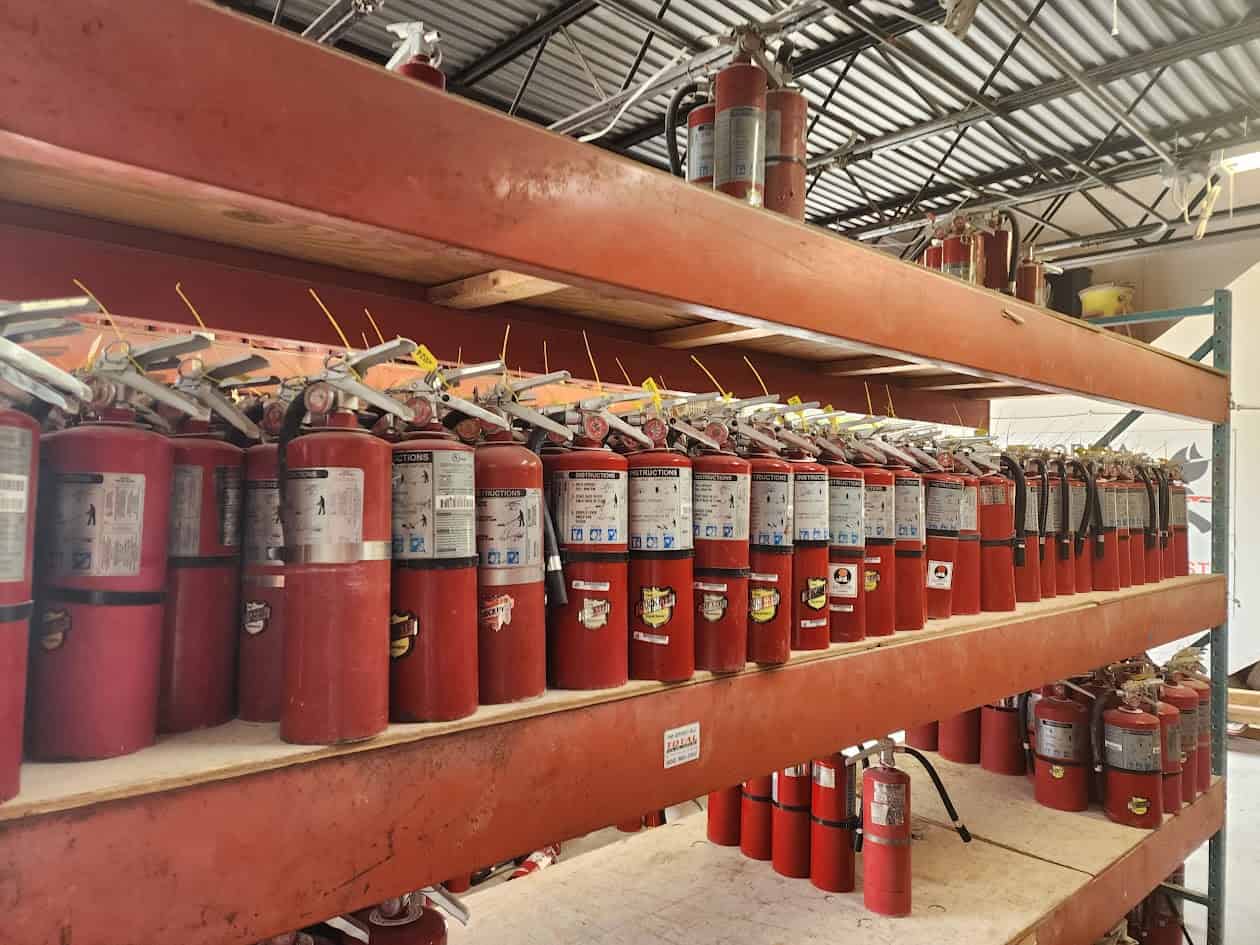
Given the number of extinguishers required on a meaningful construction project and the heightened risk of damage, loss. And discharge on active construction sites, cost-effective sourcing is a legitimate operational priority. Certified refurbished fire extinguishers from Serviced Fire Equipment provide the same compliance and performance as new units at 40-60% less cost. A significant savings when equipping a 30-unit project.
In practice, Contractors working in St. Petersburg, Tampa, Brandon, Riverview, Lakewood Ranch, Bradenton, and Sarasota County regularly supply their construction projects from Serviced Fire Equipment’s St. Petersburg facility. Our walk-in model makes it easy to pick up certified units when needed and return discharged or damaged units for recharging or replacement without scheduling delays. Certified refurbished extinguishers for construction | Bulk rental option | Contact us for contractor pricing.
Need certified extinguishers for your construction site?
We supply tagged, DOT-compliant units for contractors. Walk in or call for bulk pricing.
(727) 620-3473 — Construction Supply3200 62nd Ave N, St. Petersburg, FL · Mon–Fri 8am–4pm
Construction Site Fire Extinguishers — Walk In or Order
OSHA-compliant ABC units, rental by unit or pallet, bulk pricing. Walk-in service, no trip fee, same-day ready.
CALL (727) 620-3473 — CONSTRUCTION SUPPLY3200 62nd Ave N, St. Petersburg, FL · Mon–Fri · Rental & Bulk Available