
Additionally, NFPA 10 & OSHA 1910.157 Compliant
Fire Extinguisher Inspection Checklist
Monthly, annual, 6-year, and hydrostatic — every inspection point your facility needs to document, with the specific NFPA 10 and OSHA requirements behind each one.
By Daniel Beauchesne, Florida State Fire Marshal Licensed Technician · License 585272-0007-2005 · Class 01 & 04 · 25+ Years
How This Checklist Is Organized
Fire extinguisher inspections are not a single event — they are four separate processes that run on different schedules and carry different documentation requirements. In general, Most facilities only think about the annual inspection. That is one of four required checks, and the monthly one carries its own OSHA documentation obligation that most safety officers are not aware of.
This checklist covers all four levels: the monthly visual check that any employee can perform, the annual inspection that must be done by a licensed technician, the 6-year internal maintenance, and the hydrostatic test schedule. Each section includes what to check, what to document, and what a failure at that level means for your compliance status.
Monthly
Visual Check
Any designated employee · Must be documented · OSHA 1910.157(e)(1)
Annual
Full Inspection
Licensed technician required · Signed tag on unit · NFPA 10 + Florida law
6-Year
Internal Maintenance
Full disassembly · Agent inspection · NFPA 10 Section 7.3
5–12 Year
Hydrostatic Test
DOT-authorized facility only · Type-dependent interval · NFPA 10 Section 8
Monthly
Monthly Visual Inspection Checklist
As a result, Authority: OSHA 1910.157(e)(1) · NFPA 10 Section 7.2 · Can be performed by a designated employee — no license required
The monthly check is a visual walk-through — not a technical inspection. Its purpose is to confirm that each extinguisher is in its designated location, has not been actuated or tampered with, and shows no obvious physical condition that would prevent operation. OSHA requires this to be documented. The date and inspector's initials must be recorded on the tag attached to the unit or in a separate inspection log.
Location & Accessibility
An extinguisher that has been moved and not returned is a compliance failure regardless of its condition.
Storage, equipment, or doors must not block access. Visibility is a separate requirement from accessibility.
A loose bracket or a unit sitting on the floor is not considered properly mounted.
OSHA 1910.157(c)(1) — heavier units must be mounted lower (top ≤3.5 ft).
Physical Condition
Surface discoloration is different from pitting or structural damage. When in doubt, flag for annual inspection.
A missing pull pin or broken tamper seal indicates possible prior actuation. Remove from service and bring in for inspection.
Debris, paint, or insects can block the discharge path. Check the nozzle opening is clear.
Faded or missing labels are a citation item. The PASS instruction must be readable.
Pressure & Charge
Red on either side — overcharged or undercharged — requires immediate service. Note: CO2 units do not have gauges; weight is the indicator.
White powder residue, dark streaking around the nozzle, or a loosened valve handle are signs of use. The unit must be recharged before it can be considered operational.
Documentation
OSHA requires documentation. A verbal check with no written record does not satisfy 1910.157(e)(1).
Anonymous records do not satisfy the intent of the documentation requirement.
Annual
Annual Inspection Checklist
In fact, Authority: NFPA 10 Section 7.3.1 · OSHA 1910.157(e)(2) · Florida Statute 633 · Must be performed by a licensed fire equipment technician
The annual inspection is a comprehensive examination of every component — external and internal indicators — performed by a qualified technician. In Florida, this must be done by a dealer licensed by the Florida State Fire Marshal under Statute 633. Self-inspection does not satisfy this requirement. The result must be documented on a dated, signed tag attached to the unit. Our annual inspection service starts at $15 per unit.
External Examination
Any condition that could weaken the pressure vessel is grounds for removal from service.
The valve is the most mechanically complex component. Corrosion around the valve stem or handle pivot indicates potential internal issues.
A cracked hose can fail to direct the agent effectively. Nozzle threads and seating must be intact.
A damaged gauge face or frozen needle must be replaced — a gauge that cannot be read is not a functional indicator.
Labels that have faded, peeled, or been painted over must be replaced. The label must match the unit type.
Charge & Agent Verification
CO2 units are weighed. Stored-pressure units are checked against gauge. Cartridge-operated units require cartridge weight verification.
Detected by inverting and shaking the unit during inspection. Compacted agent will not discharge properly. If detected, the unit requires 6-year internal maintenance.
Documentation Requirements
Florida law requires the technician's license number on the tag. An unsigned or undated tag does not constitute a valid inspection record.
OSHA 1910.157(e)(4) requires that maintenance records be available for inspection.
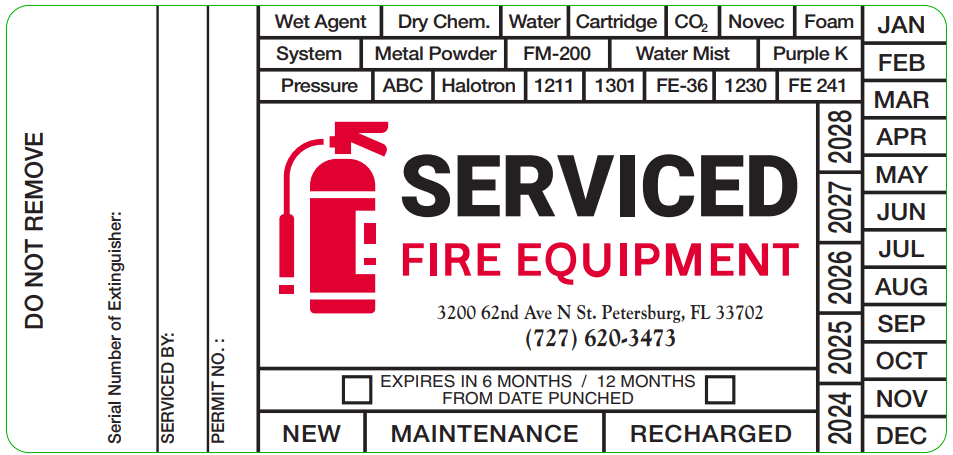
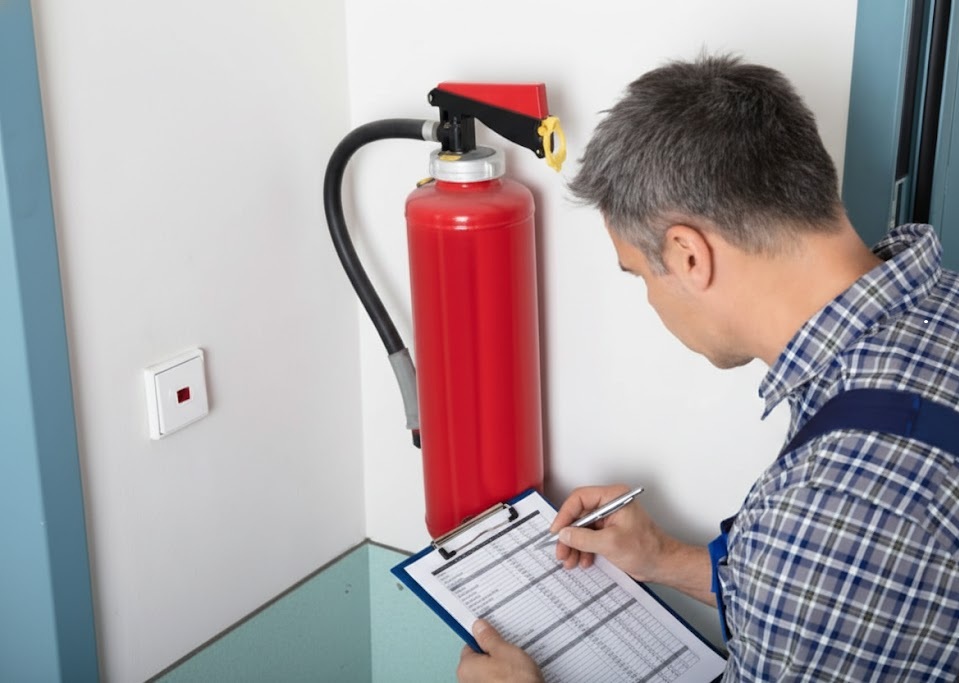
In short, A current signed tag is the documentation OSHA inspectors look for first
6-Year
6-Year Internal Maintenance Checklist
Similarly, Authority: NFPA 10 Section 7.3.2 · Applies to all stored-pressure extinguishers · Must be performed by a licensed technician
In practice, The 6-year internal maintenance is a complete disassembly and internal inspection — it goes far beyond what can be verified externally. In particular, The unit is fully discharged, taken apart, and each internal component is examined and replaced as needed before the unit is reassembled and recharged. This is the most commonly skipped maintenance requirement, and the one most likely to reveal a unit that would have failed to discharge correctly. Learn more about 6-year maintenance intervals and what they cover.
Disassembly & Internal Inspection
A stored-pressure unit must be completely discharged before the valve can be safely removed.
Internal corrosion is invisible from outside. Moisture in the cylinder body is a common finding on older units and causes agent caking.
A blocked or cracked dip tube will prevent agent from reaching the valve during discharge.
Compacted dry chemical is a common failure mode. Agent that will not flow freely through the dip tube must be replaced.
Valve & O-Ring Service
O-rings harden and lose elasticity over time. Replacement at every 6-year service is standard practice regardless of visible condition.
A worn valve stem can cause slow pressure loss between inspections or failure to fully seal after actuation.
Only manufacturer-specified agents and the correct fill weight may be used. Substituting agent types is a violation.
Documentation
The 6-year maintenance collar is separate from the annual inspection tag and must show the maintenance date.
This record is your evidence of compliance. Retain it for at least one year per OSHA requirements.
Hydrostatic
Hydrostatic Testing Checklist & Intervals
Also, Authority: NFPA 10 Section 8 · OSHA 1910.157(f) · Must be performed by a DOT-authorized facility
Hydrostatic testing is the only way to verify that a cylinder can safely contain its rated pressure. It must be performed by a facility with DOT authorization and proper test equipment. Serviced Fire Equipment is DOT-authorized for hydrostatic testing (RIN D133). The test interval depends on the extinguisher type.
| Extinguisher Type | Test Interval | Test Pressure | Hose Test? |
|---|---|---|---|
| Stored pressure dry chemical (ABC, BC, Purple K) | Every 12 years | Per manufacturer spec | No |
| CO2 | Every 5 years | 5/3 of service pressure | Yes — every 5 years |
| Water, AFFF, FFFP (stored pressure) | Every 5 years | Per manufacturer spec | No |
| Wet chemical / Class K | Every 5 years | Per manufacturer spec | No |
| Clean agent (Halotron, Cleanguard) | Every 12 years | Per manufacturer spec | No |
| Cartridge-operated dry chemical | Every 12 years | Per manufacturer spec | No |
This is the permanent record on the unit. Old test dates must be obliterated before new stamp is applied.
OSHA requires this documentation to be available for inspection. Retain for at least one year.
A condemned cylinder must be physically destroyed or rendered permanently inoperable. It cannot be put back on the wall.
What to Do When an Inspection Fails
Not every deficiency found during inspection requires the same response. Some issues require immediate removal from service. Others can be corrected at the next scheduled maintenance. Knowing the difference prevents both over-reaction and under-reaction.
Remove from service immediately
- Pull pin missing or tamper seal broken
- Gauge reading in the red (either direction)
- Visible evidence of discharge or prior use
- Hose cracked, split, or missing
- Deep corrosion, pitting, or weld cracks on cylinder
- Unit has been physically damaged (dropped, dented)
- Nozzle or valve is missing or damaged
Schedule service — do not remove unless imminent hazard
- Annual inspection tag expired or missing
- 6-year maintenance overdue
- Hydrostatic test overdue
- Operating label faded but unit otherwise functional
- Surface rust without deep pitting
- Mounting bracket loose but unit still hung
Real Talk
When you pull an extinguisher from service, you need a replacement in place before the unit leaves the wall — not after. In general, A location without an extinguisher is a compliance failure the same as a non-functional unit. We keep swap-ready units in stock for exactly this reason. Our walk-in service lets you bring in the deficient unit and leave with a certified replacement the same day.
Frequently Asked Questions
How often does a fire extinguisher need to be inspected?
A monthly visual check is required under OSHA 1910.157 and must be documented. In short, An annual inspection by a licensed technician is required under both OSHA and NFPA 10 — and in Florida, under state law as well. Additionally, stored-pressure extinguishers require internal maintenance every 6 years and hydrostatic testing every 5 or 12 years depending on type. All four are separate requirements that run on their own schedules.
Can I inspect my own fire extinguishers?
You can perform the monthly visual check yourself — it does not require a license. The annual inspection is a different matter. OSHA requires it to be performed by a "qualified person," and in Florida, state law requires a dealer licensed by the Florida State Fire Marshal. Self-inspection does not satisfy either requirement. The signed tag that a licensed technician places on the unit is your documentation of compliance — without it, you have no proof of inspection.
What does a fire extinguisher inspection tag need to include?
At minimum, the tag must show the date of the inspection and the technician's signature. In Florida, the technician's license number is also required. Tags that are present but undated, unsigned, or illegible do not satisfy the documentation requirement. Tags must remain on the unit and be accessible to inspectors — not filed away in an office.
What is the difference between annual inspection and 6-year maintenance?
The annual inspection is an external examination — pressure, physical condition, label, tamper seal, and accessible components. In practice, It does not require disassembly. The 6-year internal maintenance requires full disassembly: the unit is discharged, the valve is removed, and the interior of the cylinder and all internal components are examined and replaced as needed. Annual inspection tells you what the outside looks like. Internal maintenance tells you whether the unit will actually work.
What happens if a fire extinguisher fails inspection?
It depends on what failed. In particular, A unit with a discharged gauge, missing pull pin, or evidence of use must be removed from service immediately and either recharged or replaced before being returned to its bracket. A unit that is simply overdue for annual inspection can remain in place while service is scheduled, but should be treated as potentially non-functional. A unit that fails hydrostatic testing is condemned and must be destroyed — it cannot be returned to service under any circumstances.
How long do I need to keep fire extinguisher inspection records?
Consequently, OSHA 1910.157(e)(4) requires that maintenance records be retained and available for inspection. Also, The standard specifies at least one year for maintenance records. In practice, keeping records for the life of the unit is advisable — a complete service history is your best defense in the event of a fire, a liability claim, or an OSHA audit. The tag on the unit covers the most recent inspection; a log or digital record covers the full history.
Tampa Bay Walk-In Service
Ready to Get Your Extinguishers Certified?
Bring them in. We perform annual inspections, 6-year internal maintenance, and hydrostatic testing in-house — all with the documentation your facility needs to satisfy OSHA 1910.157, NFPA 10, and Florida Statute 633. No appointment needed.
Location
Business Hours
Walk-ins welcome, no appointment
Pricing Reference
(starting price)
(starting price)
(starting price)
In-House
RIN D133 authorized