Most business owners know they need to do “something” monthly to maintain their fire extinguishers, but they’re not always sure what that something is. The good news: monthly fire extinguisher inspections aren’t complicated, don’t require special training, and don’t require a licensed technician. The slightly more involved news: they do need to be done correctly and documented, because they’re part of NFPA 10 compliance and an actual compliance gap (not just a missed checkbox).
This guide walks through exactly how to perform monthly fire extinguisher inspections at your business, what to look for, how to document them properly, and where the line is between work you can do yourself and work that requires a Florida-licensed professional.
What Monthly Inspections Cover (vs. Annual)
NFPA 10 distinguishes between three types of work:
Monthly visual inspections are quick checks (1-3 minutes per unit) that any responsible employee can perform. They verify the unit is still in place, accessible, and apparently functional.
Annual professional inspections are thorough examinations by a Florida State Fire Marshal Class 01-licensed technician. These take 5-10 minutes per unit and involve scale weighing, internal inspection, parts replacement, and new service tag issuance.
Multi-year maintenance and testing (6-year internal maintenance and 12-year hydrostatic testing) are deep services performed by licensed technicians at major intervals.
Monthly inspections don’t replace any of the deeper work — they complement it by catching obvious problems between professional inspections.
The Monthly Inspection Checklist
For each fire extinguisher, monthly, check:
Location and accessibility:
- Unit is in its designated mounting location
- No obstructions within 36 inches (boxes, equipment, stored material)
- Wall-mounted unit is properly secured to its bracket
- Signage above unit (where required) is visible and undamaged
Visual condition:
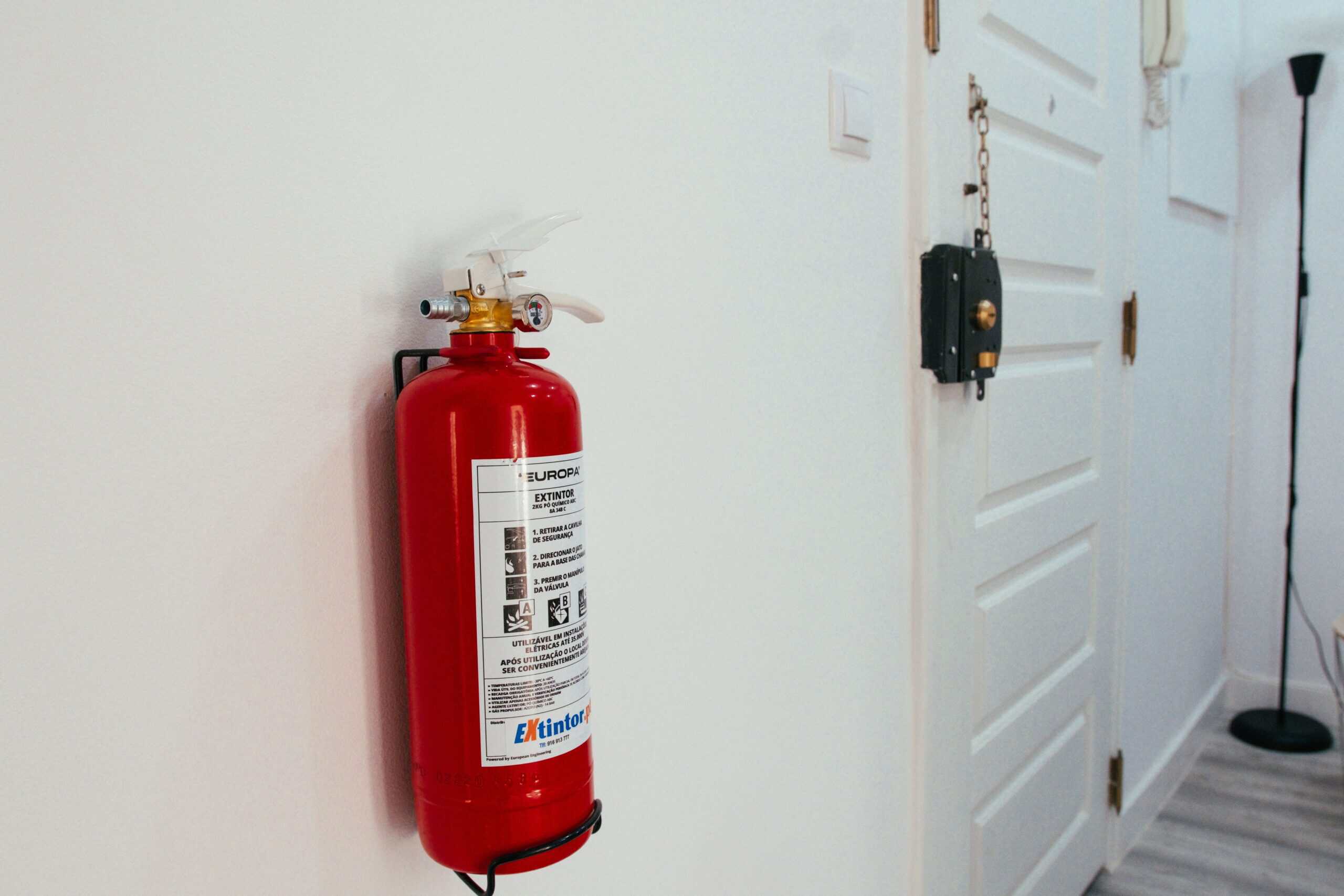
- No visible damage to the cylinder body — dents, cracks, severe scratches
- No corrosion or rust, particularly at the base of the cylinder
- Operating instructions and labels are legible and facing outward
- HMIS/NFPA hazard labels (if applicable) are intact
Pressure gauge:
- Needle is in the green operating range
- Gauge glass is undamaged
- Needle is not stuck — gently tap the gauge to verify it moves freely
Safety features:
- Pull pin is in place
- Tamper seal is intact (not broken, not missing)
- Lever is in proper position, not bent or damaged
Hose and nozzle:
- Hose (if equipped) is not cracked, kinked, or detached
- Nozzle is unobstructed
- Discharge horn (CO2 units) is undamaged
Service tag:
- Service tag is present and attached
- Most recent inspection date is within 12 months
- Tag is legible
For a printable version of this checklist, see our monthly inspection checklist resource.
How Long Does a Monthly Inspection Take?
For a typical small to mid-size business, monthly inspections take 30-90 seconds per unit. A facility with 10 extinguishers can be fully inspected in 10-15 minutes including documentation.
The fastest workflow:
- Print or open your inspection log/spreadsheet
- Walk to each extinguisher in turn
- Visually scan each item from the checklist
- Note any issues found
- Initial and date the log entry
- If any unit fails any item, flag it for professional service
Many businesses include this in a designated employee’s monthly responsibilities — typically a safety officer, facility manager, or office manager. For larger facilities, designating a backup inspector ensures continuity during vacations.
What to Do When a Unit Fails Inspection
If any item on the monthly checklist fails:
Pressure gauge in red: Remove the unit from service. Tag it as “Out of Service.” Schedule professional inspection or recharge. Don’t wait for the next annual cycle — failed pressure indicates leaking or temperature damage that needs immediate attention.
Missing or broken tamper seal: The unit may have been activated even partially. Even if it appears full, integrity is suspect. Schedule professional inspection.
Visible damage to cylinder: Surface scratches typically aren’t immediate failures, but dents, cracks, or significant corrosion should be evaluated by a professional. Damage on a weld seam is particularly serious.
Missing or expired service tag: The unit is out of NFPA 10 compliance. Schedule annual inspection immediately. Most fire marshals issue citations on this within hours of identifying it.
Obstruction or accessibility issue: Fix immediately by relocating obstructions or repositioning the unit. This is your responsibility, not the fire equipment company’s.
Hose or nozzle damage: Schedule professional service for repair or replacement. Most parts can be replaced inexpensively without replacing the full unit.
Document all findings, document the corrective action taken, and date everything. This documentation is your evidence of compliance during fire marshal inspections.
Documentation Requirements
NFPA 10 requires that monthly inspections be documented. The format isn’t strictly regulated, but the documentation must include:
- Date of each inspection
- Identification of the unit inspected (location, serial number, or unique ID)
- Confirmation that inspection items were checked
- Notation of any issues found
- Initials or signature of the inspector
Practical documentation formats that work well:
Clipboard log per facility area: Simple, fast, easy to maintain. Works well for small facilities with 5-20 units.
Spreadsheet log: Better for larger facilities. Allows trend tracking and easier search during fire marshal inspections.
Digital inspection app: Several smartphone apps generate compliant inspection records. Best for multi-location businesses or those wanting to integrate inspection data with facility management systems.
Back-of-service-tag entries: Many service tags include space on the back for monthly inspection initials. Simple but limits documentation depth.
What You CAN’T Do Yourself
Monthly visual inspections require no licensing. But several common-sounding tasks DO require professional credentials:
Recharging: Refilling a discharged extinguisher requires Florida State Fire Marshal Class 01 licensing. DIY recharging using consumer-grade products doesn’t meet compliance requirements and may damage the unit.
Annual inspections: The thorough annual inspection (with weight verification, internal examination, parts replacement) requires a licensed technician. Monthly visual inspections don’t substitute.
Internal maintenance: The 6-year internal maintenance for stored-pressure dry chemical units requires professional service.
Hydrostatic testing: Requires DOT certification — see our DOT-certified hydrostatic testing service for context.
Repair beyond minor cosmetic: Replacement of damaged valves, gauges, or other operating components requires licensed service. Don’t attempt repairs that go beyond basic external cleaning.
Decommissioning: Proper disposal of fire extinguishers requires controlled depressurization. See our disposal service for safe end-of-life handling.
Training Your Staff for Monthly Inspections
For monthly inspections to actually catch problems, the inspector needs to know what they’re looking at. Training basics:
Pressure gauge interpretation: Show staff what “green” looks like on the specific gauges in your facility. Some gauges have multiple zones; some are simple two-zone (green/red).
Tamper seal recognition: Different manufacturers use different seal designs. Make sure staff can identify intact vs. broken seals on your specific units.
Service tag reading: Train staff to identify the inspection date, expiration date, and license number on tags. Expired tags are the most common citation issue and the easiest to catch.
What “good” looks like: Show staff a fully compliant unit. Better than just describing problems, having a reference for normal makes spotting abnormal easier.
When to escalate: Train staff on which findings require immediate action vs. routine scheduling. Failed pressure or missing tag = immediate. Minor cosmetic damage = scheduled service.
For businesses across St. Petersburg, Tampa, Brandon, Pinellas Park, and Riverview, we can include a brief training overview during annual inspection visits.
Annual Service: What Happens and What to Expect
While monthly inspections are your responsibility, annual service is performed by us (or another licensed provider). What to expect during an annual inspection:
- Each unit is weighed on a calibrated scale
- Pressure is verified through the gauge and operational test
- External cylinder is examined for damage and corrosion
- Pull pin and tamper seal are replaced
- O-rings and gauges are inspected and replaced as needed
- Hose and nozzle are examined and tested
- New service tag is attached with current date, technician’s license number, and next-due date
- Any 6-year or 12-year service milestones approaching are flagged for scheduling
Cost runs $15-$22 per unit plus a service call fee ($75-$125) for on-site service, or $0 service call for walk-ins at our St. Petersburg location.
Building a Sustainable Inspection Routine
The businesses that maintain consistent compliance over years share a few common practices:
Calendar reminder for monthly inspections. Same day or week each month. Some businesses do the first Monday; others tie to month-end.
Designated primary and backup inspector. One person owns the task; backup covers vacations.
Single documentation system. Don’t mix paper logs, spreadsheets, and apps — pick one and stick with it.
Annual service scheduled in advance. Schedule the same calendar week each year. Set the next year’s appointment at the current year’s service visit.
Track unit-level service history. Know which units are approaching 6-year maintenance or 12-year hydrostatic testing. Don’t get surprised by major service events.
Annual training refresher. Five minutes during a staff meeting to review the inspection checklist keeps the routine consistent.
The Bottom Line
Monthly fire extinguisher inspections are straightforward, fast, and require no special licensing — but they have to be done consistently and documented properly to satisfy NFPA 10 compliance requirements. Done right, they take 10-15 minutes per month for typical small businesses and catch most problems before they become citations or worse. Done wrong (skipped or undocumented), they’re the gap that turns a routine fire marshal visit into a compliance problem.
Annual Fire Extinguisher Service in Tampa Bay
Serviced Fire Equipment provides annual professional inspections for businesses across Tampa Bay. Florida State Fire Marshal Class 01 and 04 licensed, Tier 1 Amerex distributor, DOT-certified for hydrostatic testing. Walk-in service at our St. Petersburg location — no service call fees.
Frequently Asked Questions
Who can do monthly fire extinguisher inspections?
Any responsible employee at your business — no special licensing or certification required. The most common designation is to a safety officer, facility manager, or office manager. Training takes 15-30 minutes; ongoing monthly inspection time is 1-3 minutes per unit. Documentation is required as part of NFPA 10 compliance.
What do I check during a monthly fire extinguisher inspection?
Verify: location is correct, no obstructions within 36 inches, pressure gauge needle is in green range, pull pin and tamper seal are intact, no visible damage to cylinder, hose/nozzle are unobstructed, operating instructions are legible, service tag is present and current. Document the inspection with date and inspector initials.
What do I do if my fire extinguisher fails its monthly inspection?
Failed pressure or missing tamper seal = remove from service, tag as out of service, schedule professional inspection immediately. Expired service tag = schedule annual inspection immediately. Obstruction or accessibility issue = fix internally. Cylinder damage = schedule professional evaluation. Document the issue, the corrective action, and the date for compliance records.
Can I refill or repair fire extinguishers myself?
No. Recharging requires Florida State Fire Marshal Class 01 licensing; pre-engineered system service requires Class 04. Hydrostatic testing requires DOT certification. Internal maintenance, valve replacement, and other deeper service work requires licensed technicians. Monthly visual inspections are the only ongoing maintenance task you can perform yourself.
How long should I keep monthly inspection records?
Best practice is to retain monthly inspection logs for at least 3 years — most fire marshal inspections look back 12-24 months, but having an additional year of records demonstrates compliance consistency. Some businesses retain indefinitely as part of their facility safety records. Format isn’t strictly regulated, but documentation must be accessible during inspections.
Annual Inspection Due? Walk In — No Appointment
Florida-licensed technicians. Inspection, 6-year maintenance, hydrostatic testing — all done in-house. From $15/unit, same day.
CALL (727) 620-3473 — WALK-IN INSPECTION3200 62nd Ave N, St. Petersburg, FL · Mon–Fri · No Service Call Fee