
Fire Extinguisher Decision Guide
CO2 vs ABC Fire Extinguisher
What each one does, what each one damages, which fires each one handles, and how to decide which belongs in your space. The answer is not always the same.
By Daniel Beauchesne, Florida State Fire Marshal Licensed Technician · License 585272-0007-2005 · Class 01 & 04 · 25+ Years
The Short Answer
An ABC dry chemical extinguisher handles the widest range of fires — ordinary combustibles, flammable liquids, and electrical equipment — and is the right choice for most general commercial and residential spaces. It leaves a corrosive dry chemical residue that requires cleanup after use.
A CO2 extinguisher handles flammable liquid and electrical fires, leaves zero residue, and will not damage electronics, servers, or sensitive equipment. It does not work on ordinary combustibles and is not suitable as a general-purpose extinguisher. It is the right choice wherever residue damage is a bigger concern than broad fire coverage.
Most facilities need both — ABC for general coverage and CO2 near server rooms, electrical panels, laboratory equipment, or anywhere dry chemical powder would cause significant secondary damage.
How Each One Works — And Why It Matters
Understanding the mechanism helps you understand both the strengths and the limitations of each type.
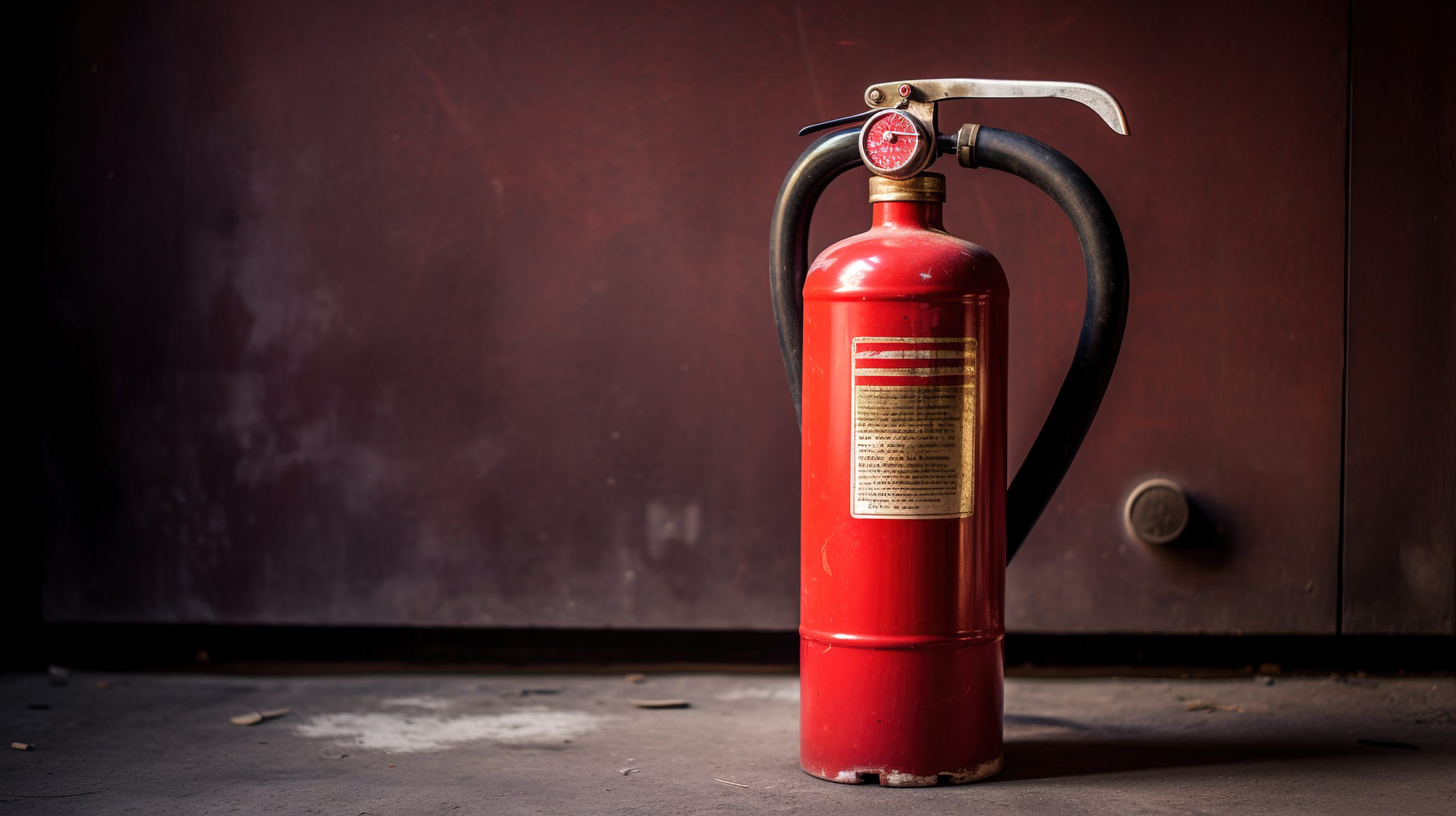
How ABC Dry Chemical Works
ABC extinguishers use monoammonium phosphate stored under nitrogen pressure. When discharged, the agent coats the burning material and interrupts the chemical chain reaction of combustion.
Effective against Class A fires because the powder coats solid burning material. Works on Class B by smothering the fuel surface. Rated for Class C because the dry chemical is non-conductive.
The tradeoff is residue. Monoammonium phosphate is acidic and corrosive — on electronics, motors, or food surfaces it causes damage, sometimes more than the fire itself.
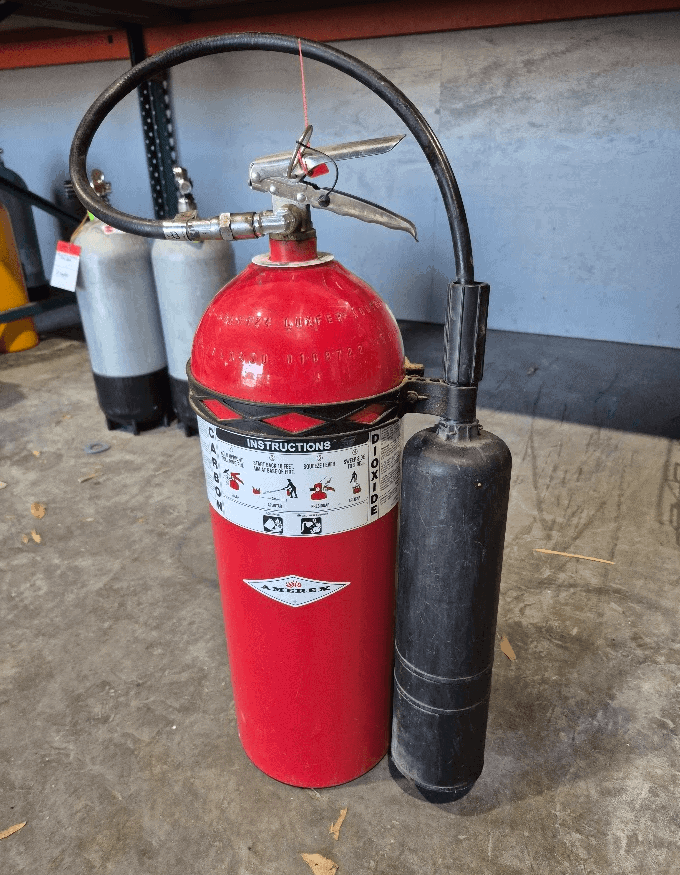
How CO2 Works
CO2 extinguishers store liquid carbon dioxide at ~850 psi. When discharged, it expands rapidly and displaces the oxygen around the fire. Without oxygen, combustion cannot continue. CO2 also creates significant cooling as it converts from liquid to gas.
Because CO2 dissipates as gas, it leaves absolutely no residue. Electronics and precision equipment are unaffected by the agent itself.
Critical limitation: CO2 is not rated for Class A fires. Wood and paper will re-ignite once the gas dissipates. CO2 also displaces oxygen for occupants — avoid use in confined unventilated spaces.
Full Comparison: CO2 vs ABC
Every practical difference that affects which one belongs in your space.
| Feature | ABC Dry Chemical | CO2 |
|---|---|---|
| Fire classes | A, B, C | B, C only — not rated for Class A |
| Extinguishing agent | Monoammonium phosphate (dry powder) | Carbon dioxide (gas) |
| Mechanism | Smothers, cools, interrupts chain reaction | Displaces oxygen, cools |
| Residue after use | Yes — corrosive yellow powder | None — gas dissipates completely |
| Safe near electronics? | No — residue damages equipment | Yes — zero agent damage |
| Confined space use | Acceptable with ventilation | Caution — displaces oxygen for occupants |
| Pressure gauge | Yes — stored-pressure gauge | No gauge — verified by weight only |
| Operating pressure | ~195 psi | ~850 psi at room temperature |
| Hydrostatic test interval | Every 12 years | Every 5 years |
| Recharge cost (starting) | $25 | $35 |
| Common sizes | 2.5 lb, 5 lb, 10 lb, 20 lb | 5 lb, 10 lb, 15 lb, 20 lb |
| Best for | General commercial and residential use, warehouses, vehicles, most workplaces | Server rooms, labs, electrical panels, anywhere residue is unacceptable |
Where Each One Belongs
The right choice depends on what you are protecting — the building and its occupants, the equipment inside, or both.
How Maintenance Differs Between CO2 and ABC
Both types require annual inspection and 6-year internal maintenance under NFPA 10. But CO2 has additional requirements that affect both the inspection process and the service cost.
ABC Dry Chemical Maintenance
CO2 Maintenance
The most common CO2 compliance failure I see is expired hydrostatic testing. Because the test is due every 5 years instead of 12, it catches people off guard — especially on units that look perfectly fine from the outside.
We perform CO2 hydrostatic testing in-house — DOT-authorized, RIN D133. Bring it in and we will test, recharge, and certify it same day.
The Most Common Mistakes When Choosing Between CO2 and ABC
After 25 years of servicing extinguishers across Tampa Bay, these are the placement errors that come up most often.
CO2 does not work on Class A fires. A warehouse or office hallway protected only by CO2 has no effective coverage for burning wood, paper, and contents. It gives people a false sense of security.
An ABC discharge next to a server rack coats every piece of equipment with acidic yellow powder. In many cases equipment loss from the discharge exceeds what the fire itself would have caused.
CO2 displaces oxygen for people as well as fires. In a small confined space a large discharge can reduce oxygen to dangerous levels quickly. "Clean" refers to the equipment, not the air.
Clean agents like Halotron and Cleanguard cover Class A, B, and C — CO2 does not cover Class A. For facilities where both fire spread and equipment protection are concerns, clean agent is the superior solution.
Frequently Asked Questions
Not effectively. The CO2 may knock the fire down temporarily, but wood retains heat and the fire re-ignites the moment the gas dissipates. CO2 is not rated for Class A fires under NFPA 10 for this reason.
Yes — CO2 is non-conductive and leaves no residue, making it the preferred choice near energized electrical equipment. After the fire is out, de-energize the power source before re-entering the area.
CO2 cylinders operate at ~850 psi versus ~195 psi for stored-pressure ABC. The higher pressure means greater cylinder wall stress over time — which is why NFPA 10 requires hydrostatic testing every 5 years for CO2 versus every 12 years for dry chemical.
With caution. A significant CO2 discharge in a small, poorly-ventilated space can drop oxygen to dangerous levels. Best practice: discharge and immediately evacuate, then ventilate before re-entry.
Both leave no residue and are safe for equipment, but clean agents like Halotron and Cleanguard are rated for Class A, B, and C — CO2 is only rated for B and C. Clean agents also do not displace oxygen, making them safer in occupied spaces. We stock and service clean agent extinguishers including Cleanguard and Halotron.
For most commercial facilities, yes. ABC covers general floor space and ordinary combustible hazards. CO2 belongs at specific locations where residue damage is a concern — server rooms, electrical panels, lab benches. Our annual inspection service includes placement review.
Not Sure Which Type You Need?
Bring in what you have. We will tell you whether it is the right type for your space, whether it is in service condition, and what it will cost to get fully compliant. No appointment needed — most visits under 10 minutes.
Business Hours
Walk-ins welcome
Pricing Reference
(starting price)
(starting price)
(starting price)
DOT RIN D133