Additionally, Fire Extinguisher Compliance Guide
What Does Fire Extinguisher Certification Mean?
Furthermore, What certification actually means under Florida law and NFPA 10, who is legally allowed to certify a fire extinguisher, what the tag records, and what to look for when verifying that your certification is legitimate.
Specifically, By Daniel Beauchesne, Florida State Fire Marshal Licensed Technician · License 585272-0007-2005 · Class 01 & 04 · Licensed since 1999
The Short Answer
Moreover, Fire extinguisher certification is the documented confirmation — by a licensed technician — that a specific extinguisher has been inspected, found to be in proper working condition, and is in compliance with applicable codes and standards. As a result, The certification is recorded on an inspection tag attached to the unit. In addition, In Florida, certification must be performed by a dealer licensed by the Florida State Fire Marshal.
Importantly, The tag is not just a sticker. Notably, It is a legal record that the extinguisher was examined by a qualified person on the date shown. In fact, During an OSHA inspection, fire marshal visit, or insurance audit, the tag is the primary evidence of compliance. A missing tag, an expired tag, or a tag signed by an unlicensed person is a citation item — regardless of whether the extinguisher itself is in good condition.
In general, Certification is required annually for all commercial fire extinguishers under NFPA 10 Section 7.3 and OSHA 1910.157(e)(3). Consequently, It is not optional and it cannot be self-performed by the business owner or an employee in a commercial setting.
What certification confirms
What certification does not confirm
What Florida Law Requires — and Why the License Matters
For instance, Florida is one of the states with specific licensing requirements for fire extinguisher service. In short, The Florida State Fire Marshal's Office issues dealer licenses under Florida Statute Chapter 633 and Florida Administrative Code Rule 69A-21. For example, These laws exist because improper fire extinguisher service — by unlicensed individuals with inadequate training or equipment — creates safety risks that the licensing requirement is designed to prevent.
Class 01 — Fire Extinguisher Dealer License
As a result, This license authorizes the holder to inspect, service, recharge, repair, and certify all types of portable fire extinguishers. Similarly, It is the license required to legally sign and issue a fire extinguisher certification tag in Florida. In practice, Without a Class 01 license, a technician cannot legally certify an extinguisher — and a certification tag signed by an unlicensed person has no legal standing.
Class 04 — Pre-Engineered Systems Dealer License
In addition, Authorizes the holder to service and certify pre-engineered fire extinguishing systems — kitchen hood suppression, vehicle systems, and industrial dry chemical systems. In practice, it is required in addition to Class 01 for dealers who service suppression systems, not just portable extinguishers.
How to verify a Florida fire extinguisher license
Notably, Florida dealer licenses are publicly verifiable through the Florida Department of Financial Services license search. In particular, The technician's license number must appear on every certification tag they issue — it is the link between the tag and the legally licensed individual who performed the work. Also, If a tag does not have a license number, it is not a compliant certification.

What the Certification Tag Actually Records
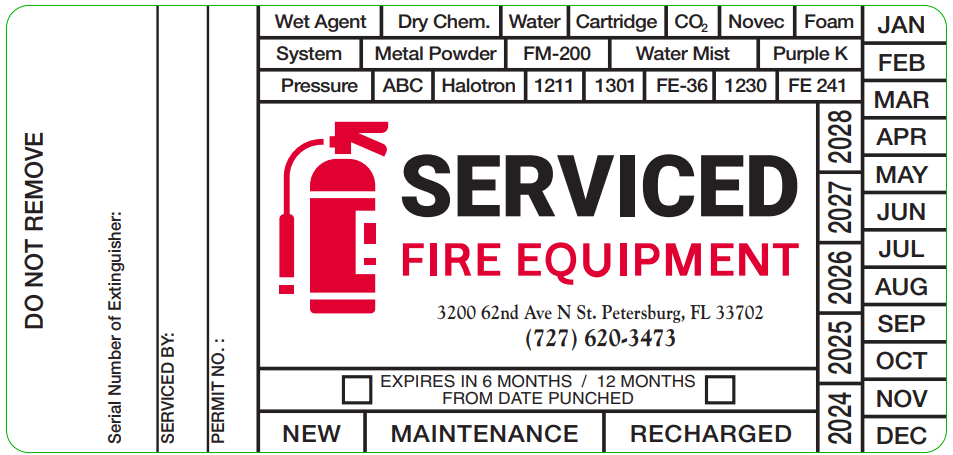
In fact, The tag on your fire extinguisher is more than a compliance sticker — it is a legal service record. Additionally, Here is what each element on a properly issued Florida certification tag means and what an inspector or auditor is looking for when they review it.
Consequently, The month and year the inspection was performed. Furthermore, This is what determines whether the certification is current — certification must be renewed within 12 months. An inspection date more than 12 months ago means the unit is overdue and not in compliance.
In short, The name and signature of the licensed technician who performed the inspection. Specifically, This creates personal accountability — the technician is signing off that the unit was inspected and found compliant at the time of certification.
For example, The license number of the dealer that performed the service. Moreover, This is the most critical element for compliance verification — it directly links the certification to a licensed entity that can be verified through the state's public license database. Importantly, A tag without a license number is not a valid certification.
Similarly, What was done during the visit — inspection only, recharge, 6-year maintenance, parts replaced. In general, This service history on the tag provides context for the next inspection and helps identify patterns or recurring issues with a specific unit over time.
In practice, A separate collar or label applied at the 6-year maintenance interval records when the internal maintenance was last performed and who performed it. This is distinct from the annual inspection tag — a unit can have a current annual tag and still be overdue for 6-year maintenance. As a result, Both must be current for full compliance.
In particular, Recorded directly on the cylinder metal — not on the tag — as a stamped date and the tester's RIN. In addition, The certification tag does not record hydrostatic test status; that information is on the cylinder body. Notably, A complete compliance picture requires checking both the tag and the cylinder stamp.
What Makes a Certification Invalid
Also, Not all certification tags are created equal. In fact, Here are the most common reasons a fire extinguisher tag does not constitute valid certification — and what to do about each one.
Expired
Additionally, Annual certification must be renewed within 12 months of the previous inspection. Consequently, An expired tag means the unit is currently out of compliance regardless of its physical condition. Bring it in for annual inspection — we will have it current the same visit.
No License #
Tag has no Florida State Fire Marshal license number
Furthermore, A tag without a license number cannot be verified and does not constitute legal certification in Florida. In short, This sometimes occurs when handyman services, general contractors, or out-of-state companies perform fire extinguisher inspections without the required Florida dealer license. For example, The work may have been done, but without the license number, it is not defensible during an OSHA or fire marshal inspection.
Unlicensed
Signed by an unlicensed person
Specifically, A business owner, facility manager, or employee cannot legally issue a fire extinguisher certification tag in Florida, regardless of how thorough their inspection was. Similarly, Florida Statute 633 reserves certification authority for licensed dealers. In practice, A self-signed tag is not compliant — period.
Missing
No tag present at all
Moreover, A fire extinguisher without a tag may have been inspected but the tag was lost, or it may never have been inspected. In particular, Either way, no tag means no verifiable compliance. Also, From an inspector's perspective, no tag equals non-compliant — the burden of proof is on the tag, not on your memory of when it was last serviced.
Unverifiable
License number does not check out
Importantly, If the license number on the tag does not correspond to a valid, active Florida State Fire Marshal dealer license, the certification is fraudulent. Additionally, This is rare but it does occur — particularly with unlicensed operators who print tags that look official. Furthermore, If you have any doubt, look up the license number at the Florida Department of Financial Services online license verification portal.
Real Talk
In general, When I take over a new commercial account, the first thing I do is look at every tag. Specifically, I have found tags with no license number more times than I can count. Moreover, I have found tags that list a company that closed years ago. I have found tags dated three years ago that nobody noticed because they just assumed the last service provider was keeping up. The tag is the only thing that matters during an inspection — the physical condition of the extinguisher is secondary to whether the paperwork is clean. Get the paperwork right.
Certification, Inspection, and Maintenance — Understanding the Difference
For instance, These three terms are often used interchangeably but they describe different things under NFPA 10. Importantly, Understanding the distinction matters for tracking your compliance obligations correctly.
| Term | What it means | Frequency | Who performs it |
|---|---|---|---|
| Visual inspection | Quick check that the unit is present, gauge is green, seal is intact, no visible damage | Monthly | Occupant / employee — no license required |
| Annual inspection / certification | Full examination of all components by a licensed technician; tag updated; any deficiencies corrected | Every 12 months | Florida State Fire Marshal licensed dealer — license # required on tag |
| 6-year internal maintenance | Full disassembly, internal inspection, complete agent replacement, valve service, recharge | Every 6 years | Florida licensed dealer — recorded on separate collar or label |
| Hydrostatic testing | Pressure test of the cylinder itself — not the agent or valve, the cylinder wall | 5 years (CO2, water) or 12 years (dry chemical) | DOT-authorized testing facility — RIN stamped on cylinder |
As a result, Full compliance under NFPA 10 and Florida law requires all four. In general, The annual certification tag addresses only the first two rows. Additionally, the 6-year maintenance collar and the hydrostatic test stamp on the cylinder body address the other two. During a fire marshal inspection, all four are subject to review.
Who Is Signing Your Certification Tag
In addition, When you bring your extinguishers to Serviced Fire Equipment, the certification is signed by Daniel Beauchesne — licensed by the Florida State Fire Marshal since 1999, with credentials that go significantly beyond the baseline requirements. For instance, Here is what is behind the signature on your tag.
State — Florida
Class 01 & Class 04 Dealer License
Notably, Authorized to inspect, certify, recharge, and service all portable fire extinguishers (Class 01) and all pre-engineered fire suppression systems including kitchen hood systems (Class 04). As a result, Both licenses verified through the Florida Department of Financial Services.
Federal — DOT
DOT-Authorized Hydrostatic Testing
In fact, Authorization from PHMSA to perform hydrostatic pressure testing on DOT-regulated cylinders. In addition, RIN D133, valid through November 2027. Notably, One of a limited number of fire equipment dealers in Florida with this federal authorization.
DOT Authorization PDF →International — ABS
ABS Marine Fire Suppression Approved
Consequently, American Bureau of Shipping approval for marine fire suppression system service. In fact, Required for commercial vessels under ABS classification. Consequently, One of the few fire equipment service facilities in the Tampa Bay area with ABS approval on file.
Industry
NAFED & FFEDA Member · 25+ Years
In short, Active member of the National Association of Fire Equipment Distributors (NAFED) and the Florida Fire Equipment Dealers Association (FFEDA). In short, In business continuously since 1999. For example, The license number on your tag has been the same for over 25 years.
Frequently Asked Questions
Is fire extinguisher certification required by law in Florida?
For example, Yes. Similarly, Florida Statute Chapter 633 and Florida Administrative Code Rule 69A-21 require that fire extinguishers in commercial occupancies be inspected and certified annually by a Florida State Fire Marshal licensed dealer. OSHA 1910.157 applies the same requirement at the federal level for workplaces covered by OSHA. Both regulations apply independently — compliance with one does not satisfy the other, though a properly certified extinguisher satisfies both simultaneously.
What happens if my extinguisher is found uncertified during a fire inspection?
Similarly, A fire marshal inspection that finds uncertified extinguishers will result in a violation notice with a required correction date. In practice, Depending on the severity and number of violations, this may include a re-inspection fee. In particular, Continued non-compliance after the correction deadline can result in escalating enforcement action. For OSHA violations, penalties for non-serious violations run up to $15,625 per violation, with repeat or willful violations significantly higher.
Does certification mean the extinguisher will work in a fire?
In practice, Certification means the extinguisher was inspected, found to be in proper working condition, and is compliant with applicable codes at the time of inspection. Also, It is the best available assurance of readiness — but it is a point-in-time snapshot. Additionally, A unit certified in January and left on the wall through an accidental discharge in March would have a current tag and no agent. This is why monthly visual checks between annual certifications matter: they catch the things that change between inspection visits.
Do I need to keep records of fire extinguisher certifications?
In particular, NFPA 10 Section 7.1.2 requires that records of all inspection and maintenance activity be retained for at least one year for inspections and five years for maintenance work. Furthermore, OSHA 1910.157 similarly requires documentation to be available for inspection. Specifically, The tag on the unit is the primary record, but keeping copies of service records for each unit is good practice — particularly for businesses with multiple locations or large numbers of extinguishers.
How much does fire extinguisher certification cost?
Also, Annual inspection and certification at our St. Petersburg walk-in facility starts at $15 per unit. Moreover, No appointment needed — bring your extinguishers in and we certify them the same visit. Most visits take under 10 minutes. If any service work is identified — recharge, parts, 6-year maintenance — we quote it on the spot and you decide before we proceed.
Can I get certification for extinguishers I didn't buy from you?
Additionally, Yes. Importantly, We inspect and certify any brand or type of fire extinguisher — Amerex, Ansul, Buckeye, Kidde, Badger, Walter Kidde, store-brand units, and everything else. In general, The certification is based on the condition of the unit and its compliance with NFPA 10 — not on where it came from. Bring in whatever you have and we will assess it, advise on any needed work, and certify it if it passes inspection.
Get Certified — Walk In, No Appointment
Furthermore, Bring your extinguishers to our St. Petersburg facility. For instance, We inspect, certify, and return them the same visit. Florida State Fire Marshal license number on every tag. Starting at $15 per unit.
St. Petersburg, FL 33702
Just off I-275
Business Hours
Walk-ins welcome
585272-0007-2005
Valid through Dec 2027
Pricing Reference
(starting price)
(starting price)
no appointment needed
no send-away