Self-Contained Breathing Apparatus (SCBA) cylinders are among the most critical pressure vessels in the fire service and industrial emergency response. When a firefighter enters a structure fire, or when an industrial emergency responder enters a hazardous atmosphere, the SCBA cylinder on their back is the only thing separating them from a lethal environment. These cylinders operate at pressures ranging from 2,216 PSI to 4,500 PSI — some of the highest pressures encountered in portable pressure vessel applications outside of industrial gas systems. The structural integrity of these cylinders is not an engineering abstraction; it’s a life safety requirement.
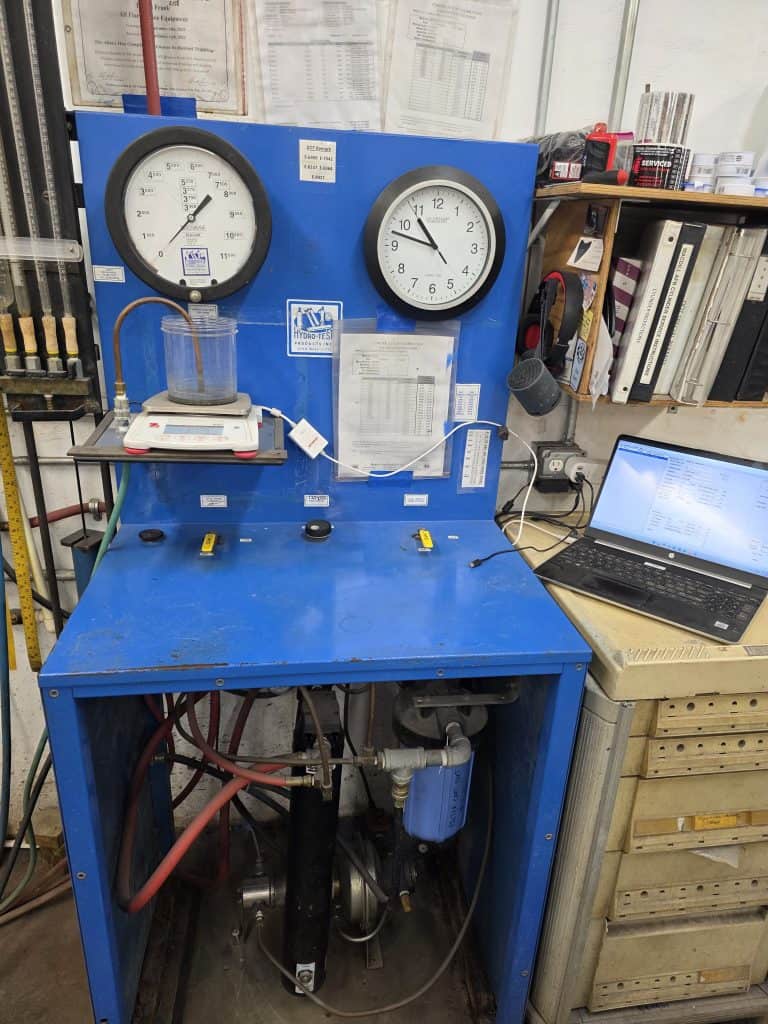
As a result, Hydrostatic testing of SCBA cylinders is the mandatory process that verifies structural integrity over the service life of these cylinders. The water jacket method, required by DOT regulations and NFPA standards, is the testing methodology that catches structural degradation before it can cause catastrophic failure in service. This guide covers why SCBA cylinder testing is critical, what the water jacket test involves, the regulatory requirements that mandate it, and where fire departments and industrial response organizations in Florida’s Tampa Bay region can access certified testing services.
What Makes SCBA Cylinders Different From Other Pressure Vessels
SCBA cylinders represent a specific design challenge: they must be extremely strong (containing 4,500 PSI in newer high-pressure cylinders) while being light enough for a firefighter to wear during active operations. This combination of high pressure and weight minimization led to the development of composite cylinders — aluminum or steel liner cylinders wrapped with carbon fiber or fiberglass fiber to achieve high strength at low weight.
That said, The composite construction is a significant engineering achievement, but it also creates specific testing and inspection requirements that differ from standard steel cylinders. Carbon fiber, while incredibly strong in tension (the fiber is pulling, not bending), can be damaged by impact events that leave no visible external damage. A cylinder that appears perfect externally may have internal carbon fiber delamination from being dropped or struck. This hidden damage can allow the cylinder to fail under pressure — a catastrophic event that would instantly kill the firefighter wearing it.
Composite SCBA cylinders also have a fixed maximum service life — typically 15 years from date of manufacture — regardless of hydrostatic test condition. After 15 years, composite cylinders must be retired regardless of how well they perform on hydrostatic testing. This is because the polymer matrix that binds the carbon fiber can degrade over time due to UV exposure, chemical exposure, and thermal cycling in a way that the hydrostatic test doesn’t fully capture. Older steel SCBA cylinders don’t have this fixed retirement age, but they do require the same 5-year hydrostatic testing schedule.
The Water Jacket Hydrostatic Test: Method and Measurement
Critically, The water jacket method is the DOT-required hydrostatic testing procedure for SCBA cylinders. Its principle is straightforward: fill the cylinder with water (eliminating compressible gas from the test), pressurize with additional water to a test pressure of 5/3 of service pressure (approximately 7,500 PSI for a 4,500 PSI service pressure cylinder), and precisely measure how much the cylinder permanently expands.
The “water jacket” in the test name refers to the sealed steel container that surrounds the cylinder during testing. Both the cylinder and the jacket are filled with water. As the cylinder is pressurized and expands, water is displaced from the annular space between the cylinder and the jacket into a calibrated measurement tube. The total water displacement during full pressurization represents the total expansion of the cylinder. When pressure is released, the water that returns to the jacket represents the elastic (recoverable) expansion. The difference — the permanent expansion — is what determines pass or fail.
Keep in mind that Manufacturer specifications for permanent expansion tolerance vary by cylinder design but are typically in the range of 10% of total expansion. A cylinder with permanent expansion within tolerance passes; one exceeding tolerance fails and must be permanently taken out of service. The critical point is that permanent expansion isn’t something a user would notice during normal operation — the cylinder doesn’t visibly change size. Only the precision measurement of the water jacket test can quantify it.
DOT Regulatory Requirements
The Department of Transportation regulates SCBA cylinders under 49 CFR 180 as compressed gas cylinders, and the NFPA 1981 Standard on Open-Circuit Self-Contained Breathing Apparatus for Emergency Services provides additional requirements for fire service SCBA specifically. The key DOT requirement for SCBA cylinders is 5-year hydrostatic testing — every cylinder must receive DOT-certified hydrostatic testing every 5 years from manufacture or from the last test date.
Consequently, For this reason, Cylinders that have not been tested within the 5-year interval are out of compliance and cannot legally be filled or put into service. For fire departments, this means SCBA cylinders with expired test dates cannot be used in operations — a compliance issue with serious operational implications if a department doesn’t track test dates carefully. For industrial emergency response organizations, the same DOT prohibition applies.
After passing hydrostatic testing, the test date is permanently stamped into the metal of the cylinder (for steel cylinders) or on a metal test tag for composite cylinders. The stamp includes the month, year, and the testing facility’s DOT requalification code — a specific identifier for each authorized testing facility. These stamps are the authoritative compliance records that inspectors, cylinder fill stations, and SCBA maintenance technicians verify.
NFPA 1981 Additional Requirements
Notably, NFPA 1981, the standard governing fire service SCBA, adds requirements beyond DOT’s hydrostatic testing mandate. Key NFPA 1981 requirements relevant to cylinder service include: annual inspection of the complete SCBA assembly; flow testing to verify the regulator delivers adequate airflow under simulated use conditions; inspection of all harness, face mask, and regulator components; and documentation of all service events in the apparatus’ service record.
Importantly, Fire departments that maintain SCBA for their personnel must track all of these requirements to maintain compliance with NFPA 1981 and the insurance and liability implications associated with it. A firefighter injured because their SCBA cylinder failed during an operation, when the failure can be attributed to missed hydrostatic testing, creates significant legal and financial exposure for the fire department. Proactive hydrostatic testing schedule management is the correct approach.
Serviced Fire Equipment’s SCBA Hydrostatic Testing Service
This means that Serviced Fire Equipment is a DOT-authorized hydrostatic testing facility in St. Petersburg, FL, providing SCBA cylinder testing for fire departments and industrial emergency response organizations throughout the Tampa Bay area. Our facility uses calibrated water jacket testing equipment operated by trained technicians, and all test results are documented with DOT-compliant test date stamps.
Notably, Our SCBA testing service accommodates the most common SCBA cylinder types: aluminum composite (Scott Air-Pak, MSA, Drager, and other major manufacturers), steel cylinders in both standard (2,216 PSI) and high-pressure (4,500 PSI) configurations. For composite cylinders, we verify the manufacturer date to confirm the cylinder has not exceeded its 15-year retirement age before investing in testing — testing a cylinder at year 14 when it will be retired next year is a useful expense; testing one that’s 17 years old is money wasted since the cylinder must be retired regardless of test results.
Notably, Fire departments in St. Petersburg, Tampa, Clearwater, Pinellas Park, Brandon, Riverview, Dunedin, Pasco County, and surrounding jurisdictions can bring SCBA cylinders to our facility for testing. We accommodate batch testing for departments with multiple cylinders needing testing simultaneously, and we provide testing documentation in the format required for apparatus service records. Learn more about our SCBA hydrostatic testing service or contact us to schedule testing for your department’s cylinders.
Complementary Services: Fire Extinguisher and SCUBA Testing
Beyond SCBA cylinders, Serviced Fire Equipment’s hydrostatic testing capabilities extend to fire extinguisher cylinders (all types — CO₂, stored-pressure dry chemical, and clean agent systems), SCUBA tanks for dive operations in the Tampa Bay area, and other industrial compressed gas cylinders on a case-by-case basis. Our facility is a one-stop testing resource for organizations that need to comply with both fire equipment and diving equipment hydrostatic testing requirements.
Specifically, The coordination of multiple pressure vessel testing at a single facility simplifies logistics for organizations managing diverse cylinder inventories. Fire departments that also operate marine rescue or dive units can bring both SCBA and SCUBA cylinders to our facility in a single service visit. Marina operations and dive charter businesses can bring SCUBA tanks alongside any CO₂ cylinders or fire extinguishers that need testing. This comprehensive testing capability makes Serviced Fire Equipment the preferred resource for pressure vessel compliance throughout Tampa Bay. Learn about all our hydrostatic testing services or contact us today.
SCBA cylinders due for hydrostatic testing?
We are DOT-authorized for SCBA hydrostatic testing. Walk in or call for availability.
(727) 620-3473 — SCBA Hydrostatic Testing3200 62nd Ave N, St. Petersburg, FL · Mon–Fri 8am–5pm
SCBA and Hydrostatic Testing Resources
SCBA Hydrostatic Testing — In-House, DOT Authorized
DOT RIN D133. We test SCBA cylinders for fire departments, dive shops, and industrial operators. Walk-in or ship to us.
CALL (727) 620-3473 — SCBA TESTINGDOT RIN D133 · St. Petersburg, FL · Fire Departments & Industry